Game Introduction
Texas Hold'em
Game Overview:
Texas Hold'em is a competitive multiplayer poker game where players combine their two private hole cards with five community cards on the table to make the strongest five-card hand and win the pot.
Number of Players: 6 – 6-Max (Short-Handed Table)
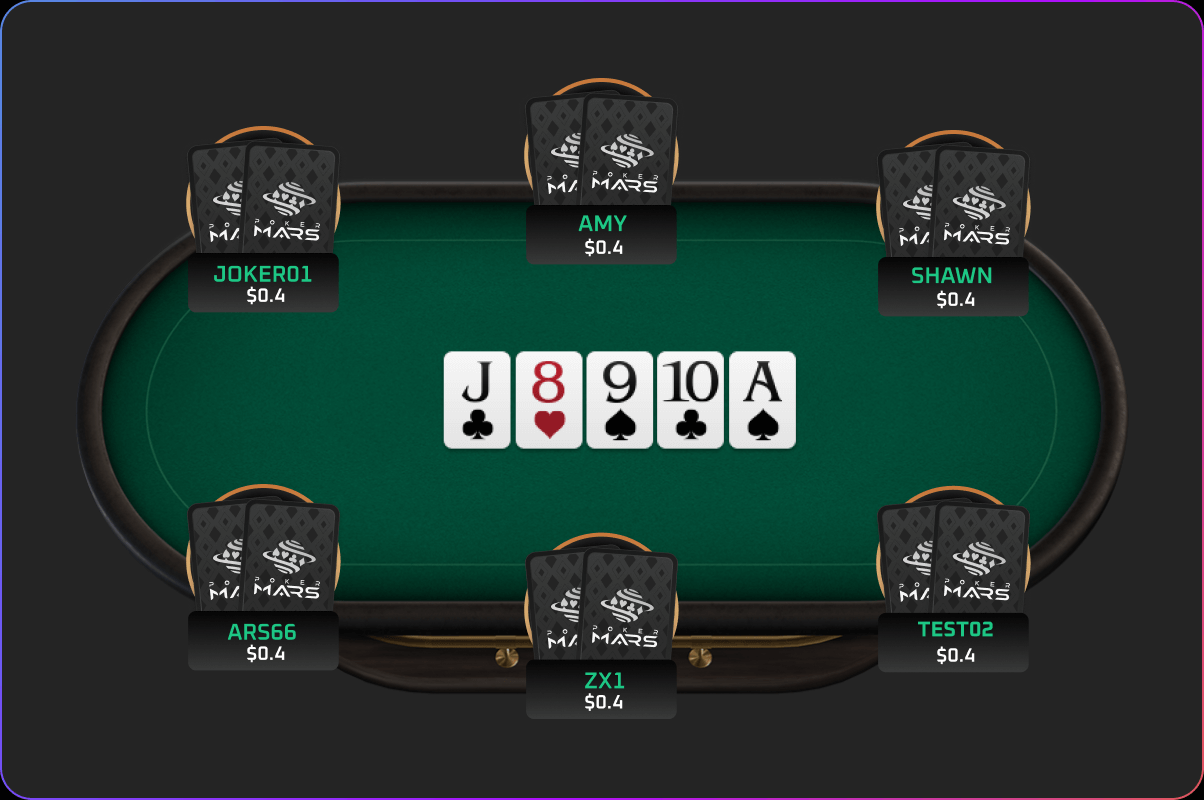
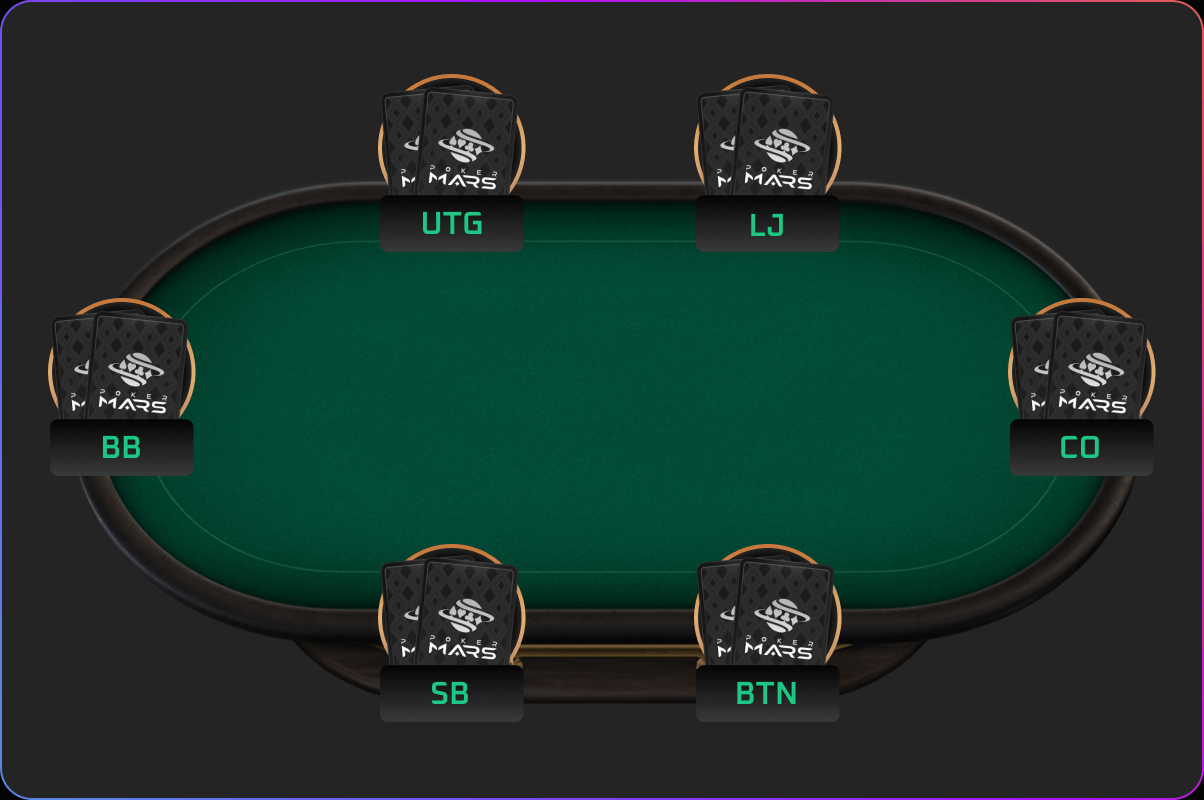
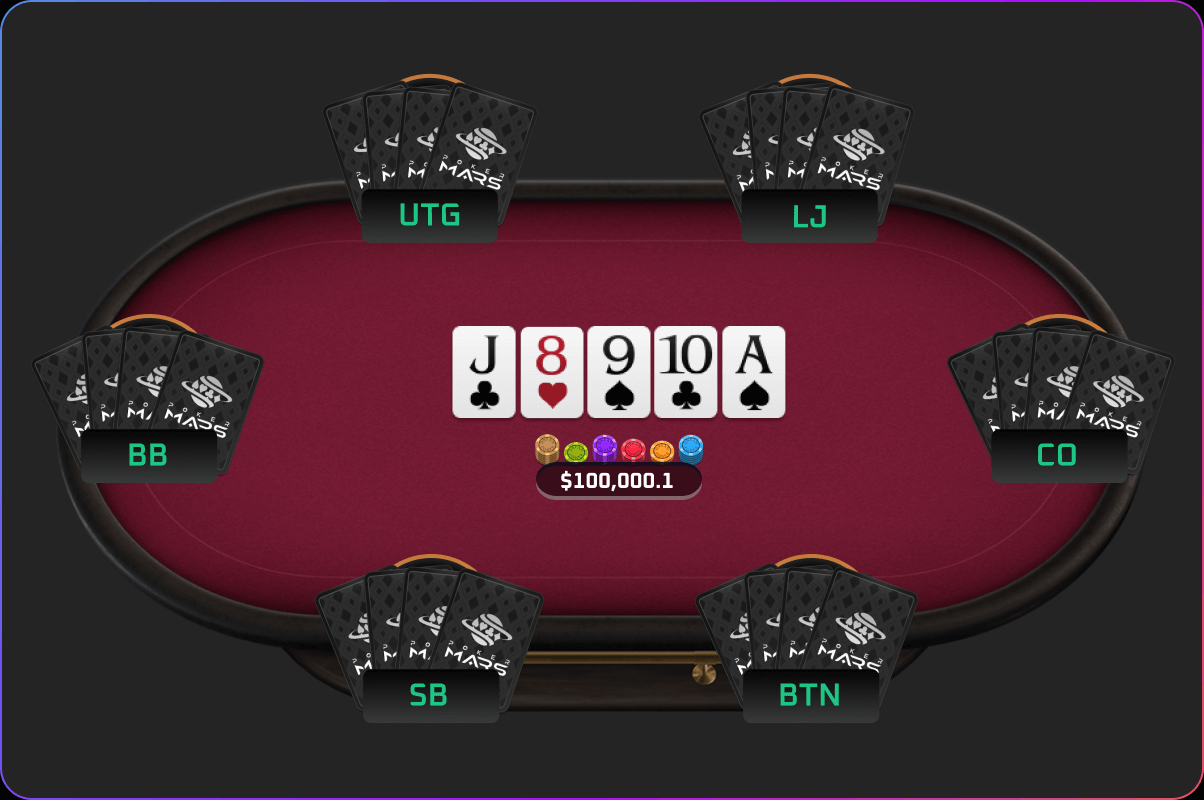
6-Max Poker Table Position Overview
Each player's seat at the table affects their betting order and strategy. Below are the standard seat names in clockwise order:
- Small Blind (SB): First seat to the left of the dealer (Button). Required to post the small blind. Acts first after the flop — considered a disadvantageous position.
- Big Blind (BB): Left of the Small Blind. Posts the big blind. Acts last preflop and sometimes sees the flop for free.
- Under the Gun (UTG): First to act preflop, located left of the Big Blind. Early position in a 6-max table; requires tight hand selection.
- LowJack (LJ): Left of UTG, considered the middle position. Allows for slightly looser opening ranges.
- CutOff (CO): Just before the Button. A strong late position with good opportunities to steal blinds and apply pressure.
- Button (BU / BTN): The dealer position. Acts last post-flop, has the most information — widely considered the most advantageous seat.
Basic Actions Explained
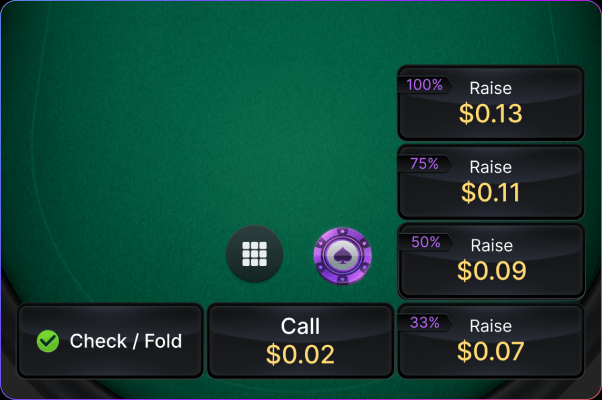
In the game, each player can take the following basic actions:
- Bet: To put chips into the pot to start the betting round.
- Call: To match the amount of the previous player's bet or raise.
- Raise: To increase the current betting amount.
- Check: To pass the action without betting, but only if no one else has bet before you in the current betting round. You remain in the hand.
- Fold: To give up your hand and forfeit your chance to win the current pot.
Game Flow Steps
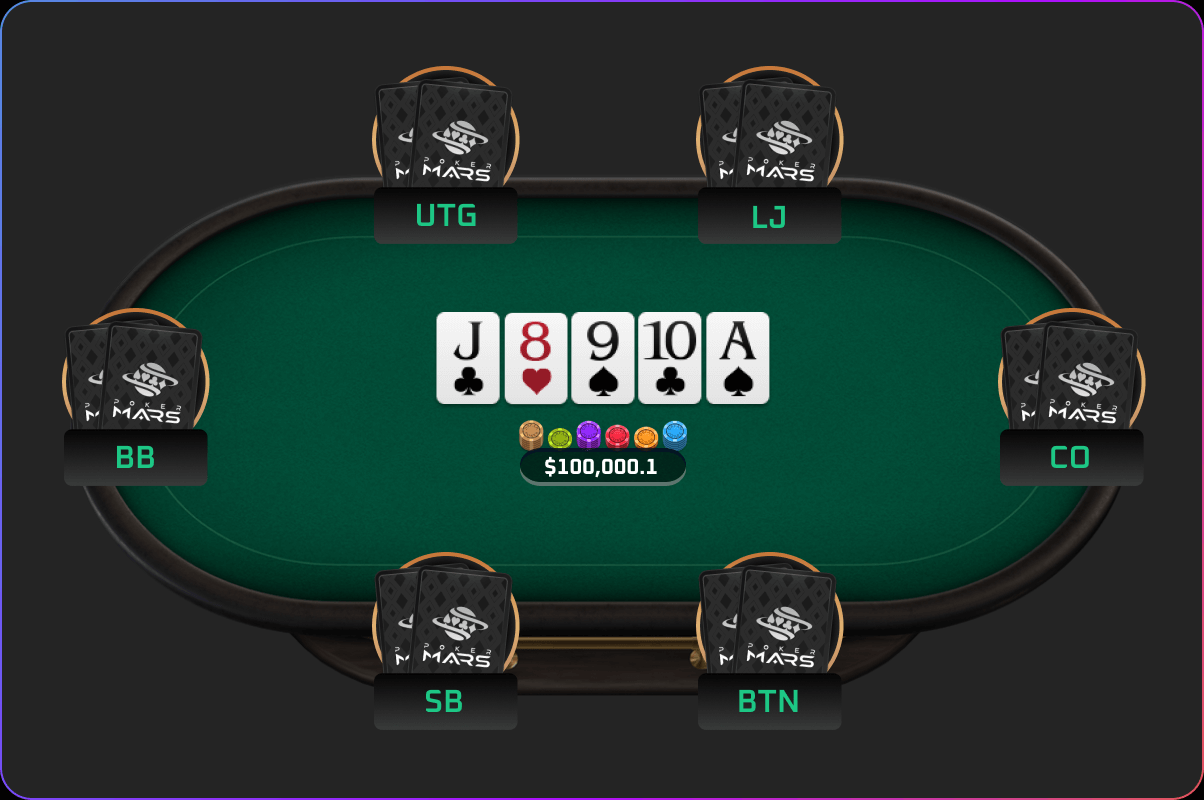
Each hand of Texas Hold'em goes through the following stages:
- Determining the Button: The dealer button position is established, either by drawing cards or system designation.
- Blinds (Small Blind & Big Blind): The players in the Small Blind (SB) and Big Blind (BB) positions are forced to make initial bets, forming the starting pot.
- Dealing Hole Cards: Each player receives two private cards, dealt face down.
- Pre-flop: This is the first betting round. Action begins with the player Under the Gun (UTG) and proceeds clockwise.
- Flop: 3 community cards are dealt, proceeding to the second round of action.
- Turn: The 4th community card is dealt, proceeding to the third round of action.
- River: The 5th community card is dealt, proceeding to the final round of action.
- Showdown: If two or more players remain in the hand after the final betting round, they reveal their cards. The player with the best five-card hand (using any combination of their two hole cards and the five community cards) wins the pot.
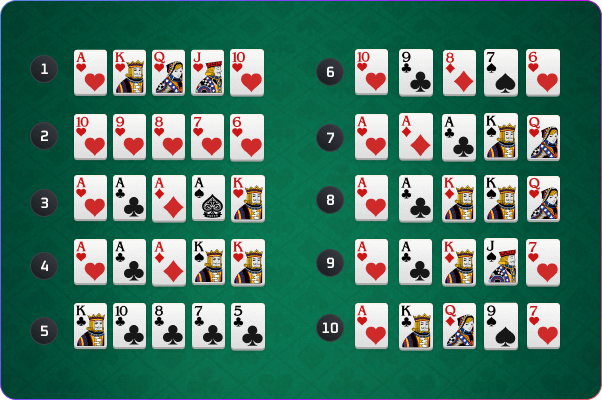
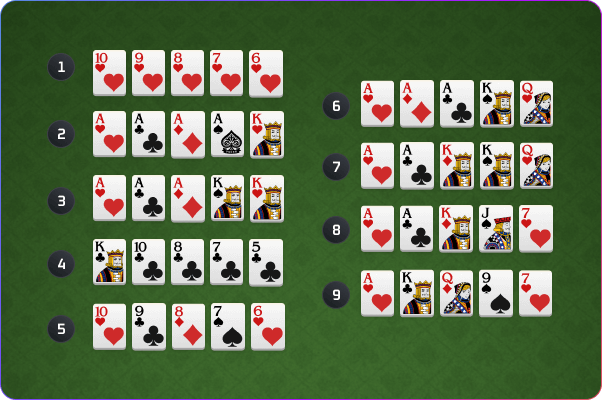
Hand Rankings (Strongest to Weakest)
In Texas Hold'em, the game is about comparing hand rankings, not the suit of the cards. Aces are the highest card, and 2s are the lowest.
- Royal Flush: A-K-Q-J-10, all of the same suit. This is the strongest possible hand.
- Straight Flush: Five consecutive cards of the same suit.
- Four of a Kind: Four cards of the same rank.
- Full House: Three cards of one rank and two cards of another rank (three of a kind and a pair).
- Flush: Five cards of the same suit, not in sequence.
- Straight: Five consecutive cards of different suits.
- Three of a Kind: Three cards of the same rank.
- Two Pair: Two different pairs.
- One Pair: Two cards of the same rank.
- High Card: When a hand has none of the above combinations, the highest-ranking card determines the winner.
Omaha
Basic
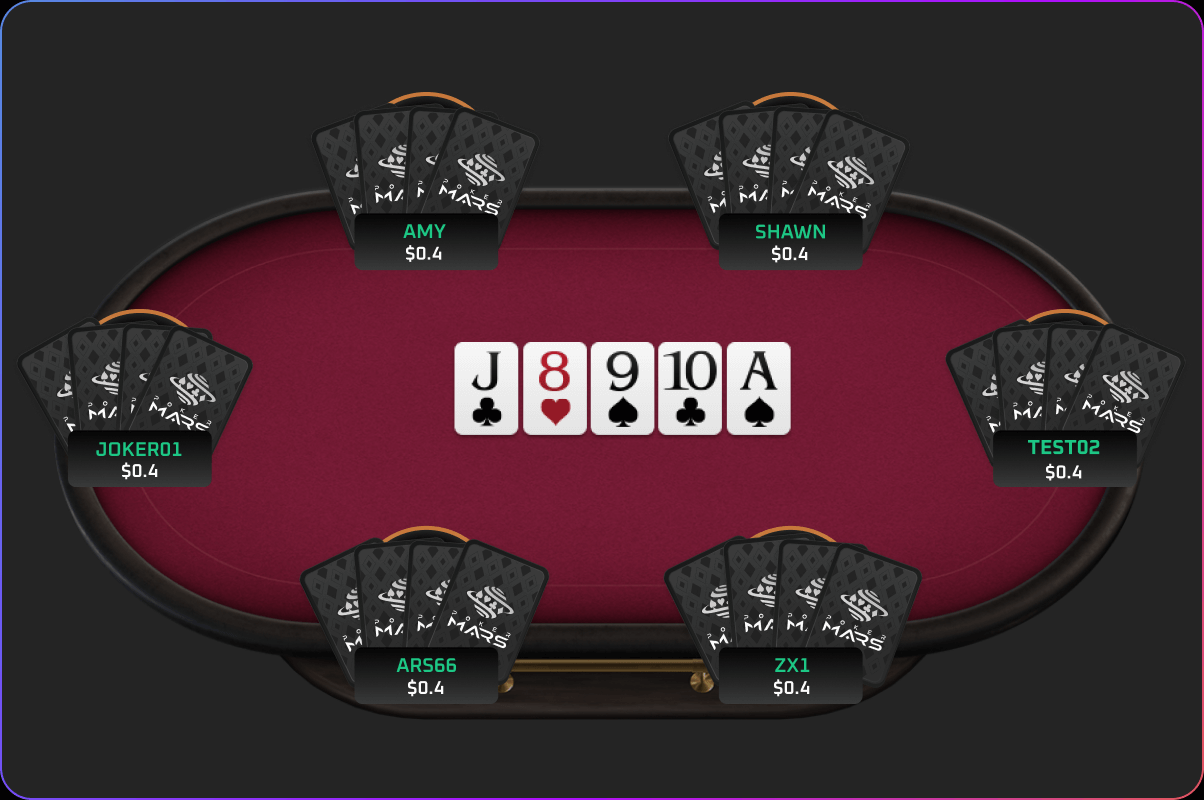
he two real differences between Omaha and Texas Hold'em are:
In Omaha, each player is dealt four hole cards.
Players can only use exactly two of their four hole cards in combination with the community cards on the table to form the best five-card hand.
Game Rules Overview
Each player's seat at the table affects their betting order and strategy. Below are the standard seat names in clockwise order:
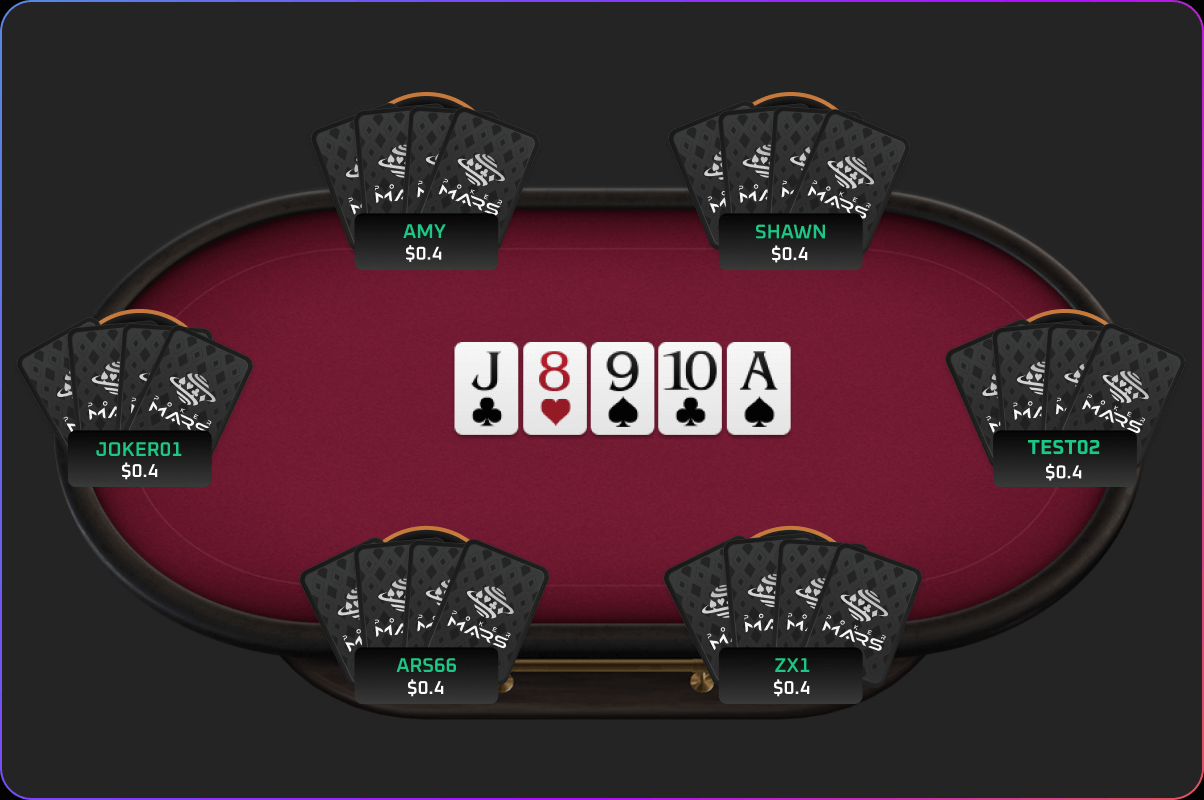
- In Omaha, each player receives four private hole cards (starting hand). There are still five community cards (Flop, Turn, and River) dealt on the table.
- To form the best five-card hand, you must use exactly two of your four hole cards combined with exactly three of the five community cards.
- The game flow is similar to Texas Hold'em:
- Deal Hole Cards → Flop → Turn → River → Showdown
- Omaha is typically played with 2 to 6 players.
- The most common forms are Omaha Hi (high-only) and Omaha Hi-Lo (high-low split).
Game Flow
- Dealing Phase: Each player receives four hole cards.
- Pre-flop: The first betting round begins, starting with the player Under the Gun (UTG).
- Flop: Three community cards are dealt face-up, and the second betting round occurs.
- Turn: One more community card is dealt face-up, followed by the third betting round.
- River: The final community card is dealt face-up, leading to the fourth and final betting round.
- Showdown: If multiple players remain, they reveal their hands to determine the winner.
Hand Building Rules
- Unlike Texas Hold'em, Omaha requires players to use exactly 2 private hole cards + 3 community cards.
- You cannot use just one hole card.
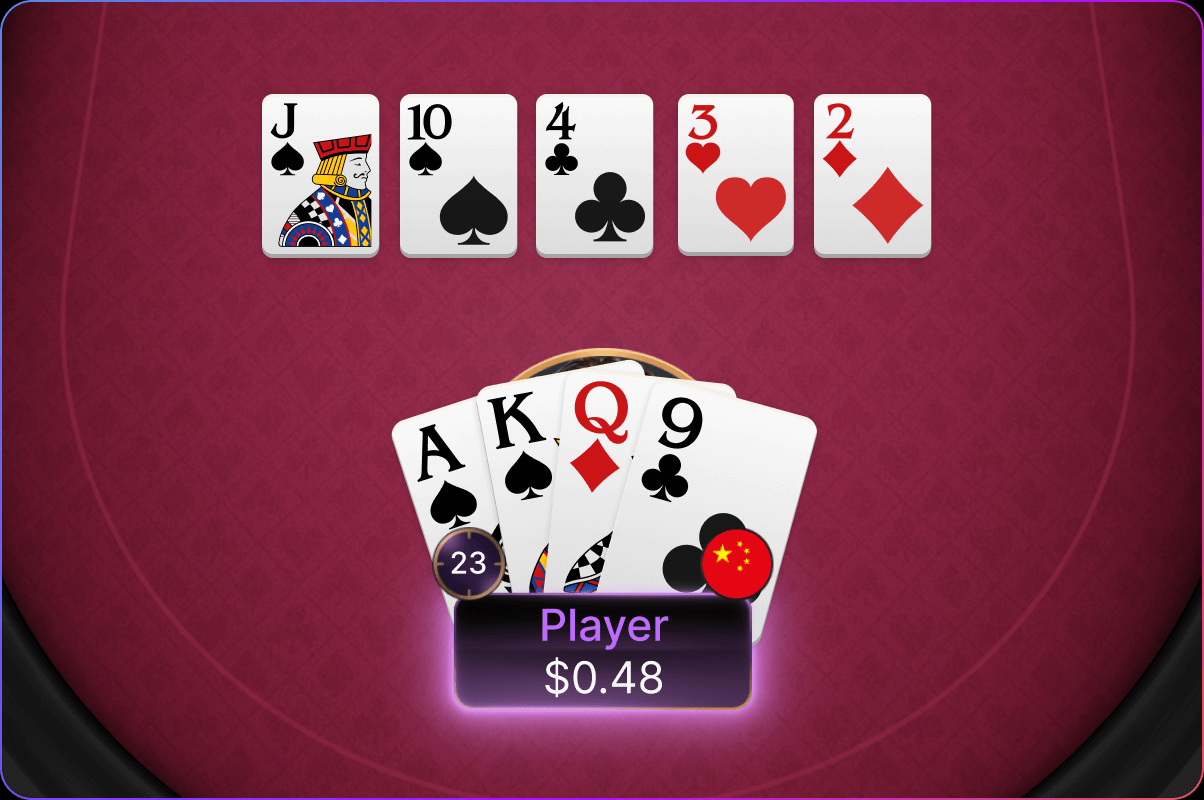
Valid combination example:
- Hole Cards: A♠ K♠ Q♦ 9♣
- Community Cards: J♠ 10♠ 4♣ 3♥ 2♦
- Correct combo → A♠ K♠ + J♠ 10♠ 4♣ → Straight Flush (A♠ K♠ Q♠ J♠ 10♠)
Card Combination Rules
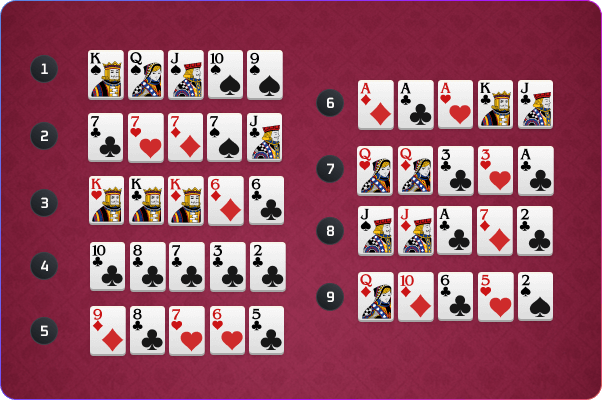
- Straight Flush: Five cards of the same suit and in sequential order. The highest-ranking Straight Flush, from 10 to Ace, is also known as a Royal Flush.
- Four of a Kind: Four cards of the same rank, accompanied by one kicker card.
- Full House: A combination of three cards of one rank and two cards of another rank.
- Flush: Five cards all of the same suit, but not in sequential order.
- Straight: Five cards in sequential order, but not all of the same suit.
- Three of a Kind: Three cards of the same rank, with two other unrelated cards.
- Two Pair: Two separate pairs of cards with the same rank, plus one unrelated fifth card.
- One Pair: A single pair of cards with the same rank, along with three other unrelated cards.
- High Card: Five cards that do not form any of the combinations listed above. The hand's strength is determined by its highest-ranking card.
All-in or Fold (AoF)
Basic
In this poker variant, each player has only two options during their turn:
- All-in: Commit all of your remaining chips to the pot.
- Fold: Give up your hand and exit the current round.
- There are no options to raise, call, or check. Players either go all-in to continue in the hand or fold and exit the game. This directly leads to either a showdown or withdrawal from the hand.
Game Flow Steps
Each player is dealt two hole cards.
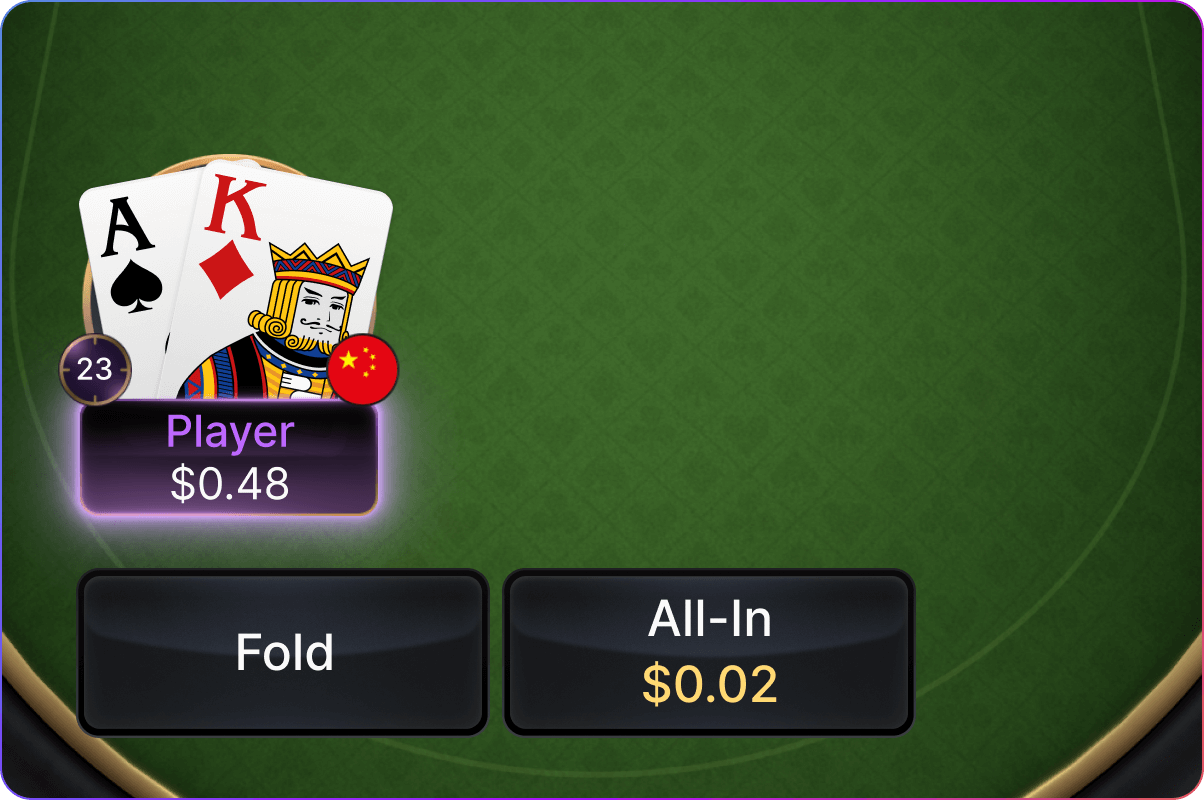
When it's your turn to act, you have only two choices:
- All-in: You push all of your chips into the pot at once.
- Fold: You give up your hand and are out of the current round.There are no options to check, call, or raise.
If multiple players choose to go all-in, then all five community cards are dealt immediately (without separate Flop, Turn, and River rounds). The remaining players then proceed directly to a showdown to determine the winner.
The winner takes the entire pot. If there are side pots created by players having different stack sizes when they go all-in, the pot will be divided accordingly (main pot / side pots).
Hand Comparison and Results
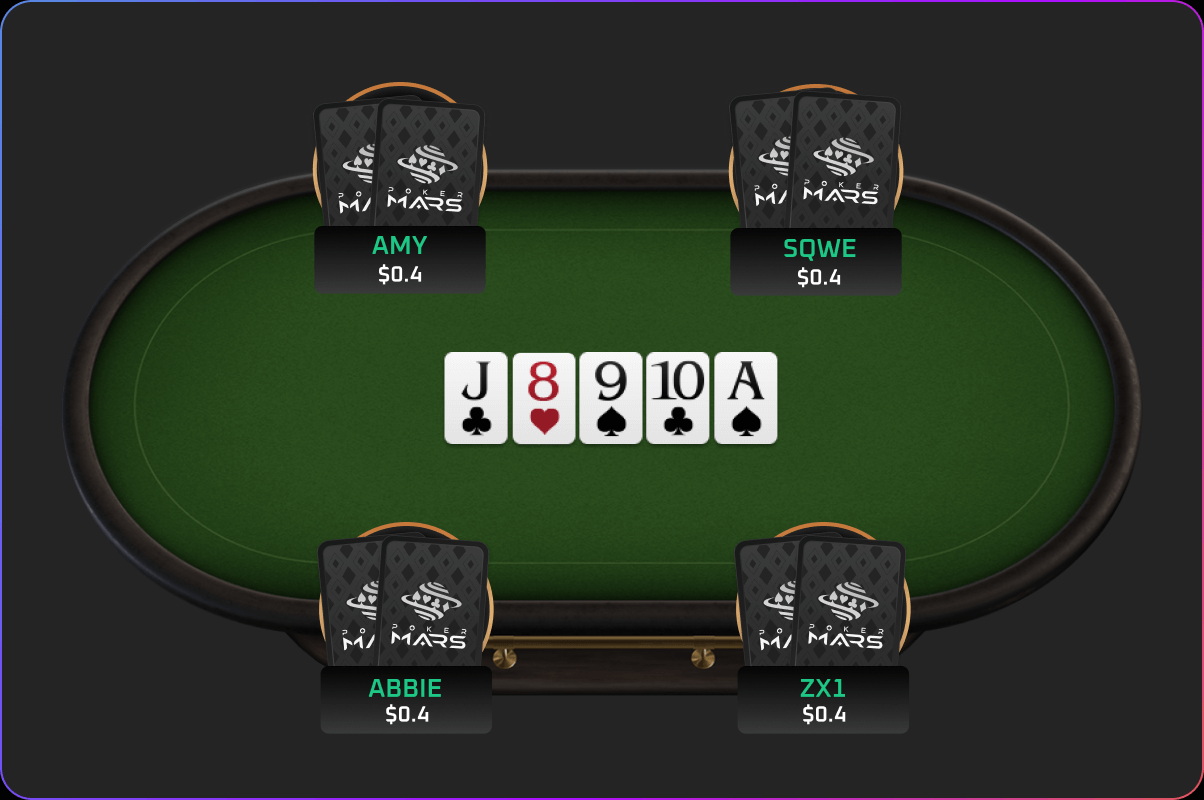
All five community cards (Flop + Turn + River) are dealt out immediately. There are no separate betting rounds for each street.
Each player then uses their hole cards combined with the community cards to form their best five-card poker hand.
The hand rankings are identical to traditional Texas Hold'em.
- Straight Flush: Five cards in sequence, all of the same suit.
- Four of a Kind: Four cards of the same rank.
- Full House: Three cards of one rank and a pair of another.
- Flush: Five cards of the same suit, not in sequence.
- Straight: Five cards in sequence, different suits.
- Three of a Kind: Three cards of the same rank.
- Two Pair: Two separate pairs.
- One Pair: One pair of cards with the same rank.
- High Card: None of the above combinations — highest card wins.
Short Deck
Basic
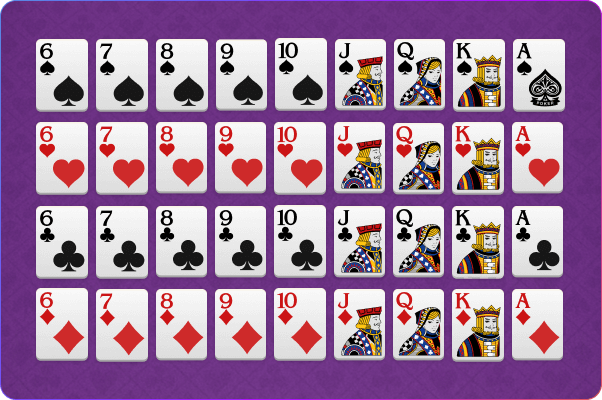
- Short Deck (also known as Six Plus Hold'em) is a variant of Texas Hold'em. While its gameplay is similar to traditional No-Limit Texas Hold'em, there are key differences in the deck composition and hand rankings.
- In this poker variant, the entire game is played with only 36 cards, as all cards with ranks from 2 through 5 are removed from the deck.
Game Rules Overview
Because some of the suits/lower cards are removed, a Flush becomes rarer than a Full House in Short Deck, hence its higher ranking.
- Deck: 36 cards (all 2s, 3s, 4s, and 5s are removed).
- Hole Cards: 2 cards
- Community Cards: 5 cards
- Hand Formation: Same as standard poker (best 5-card hand from your two hole cards and five community cards).
- Smallest Straight: A-6-7-8-9 (Ace acts as a 5 for this straight).
- Ace Value: Ace can represent both a high Ace and a low 5 (for the A-6-7-8-9 straight).
- Hand Rankings: See below for specific hand rankings.
Hand Ranking
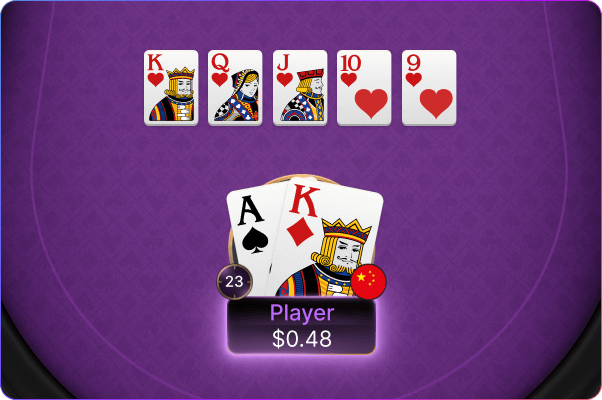
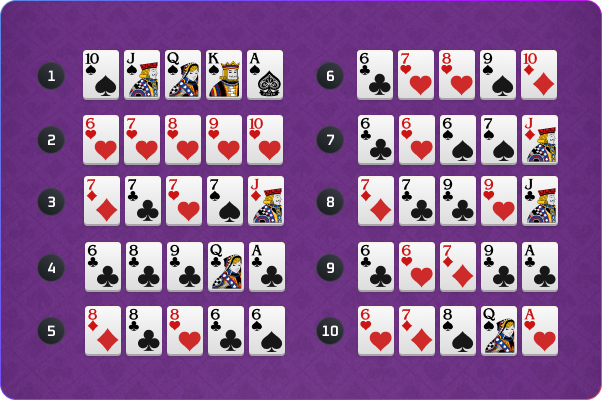
- Royal Flush: Five consecutive cards of the same suit, from Ten to Ace (T-J-Q-K-A).
- Straight Flush: Five consecutive cards of the same suit.
- Four of a Kind: Four cards of the same rank.
- Flush: Five cards of the same suit (not consecutive).
- Full House: Three cards of one rank and two cards of another rank.
- Straight: Five consecutive cards of different suits. Remember, the smallest straight is A-6-7-8-9 (where the Ace acts as a 5).
- Three of a Kind: Three cards of the same rank.
- Two Pair: Two separate pairs of cards.
- One Pair: Two cards of the same rank.
- High Card: When no other hand combination can be made, the hand with the highest-ranking single card wins.
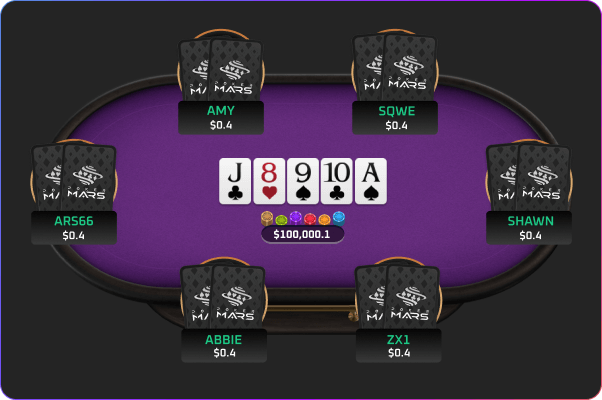
Game Flow Steps
Deal: Each player takes 2 cards
Betting Rounds
- Pre-flop: The first betting round takes place before any community cards are dealt.
- Flop: Three community cards are dealt face-up, followed by the second betting round.
- Turn: A fourth community card is dealt face-up, and the third betting round occurs.
- River: The fifth and final community card is dealt face-up, leading to the last betting round.
Showdown: If more than one player remains after the final betting round, the players reveal their hands in a showdown, and the best hand wins the pot.
Pineapple
Basic Gameplay Rules
Players: 2–3 players; 52 cards (standard mode), 54 cards (joker mode).
Number of rounds: 5 rounds
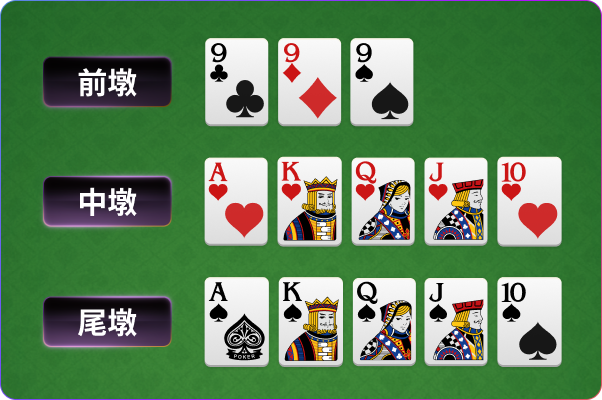
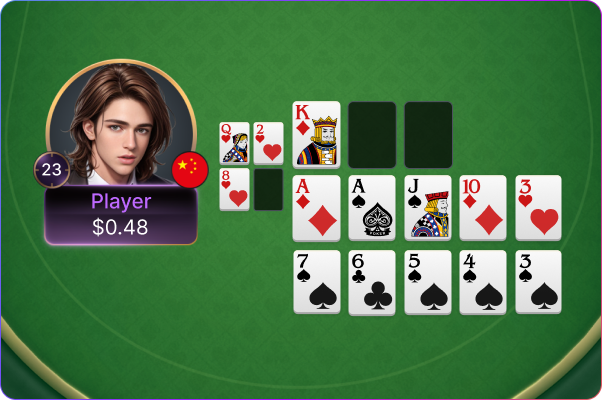
- Round 1: Each player receives 5 cards and freely arranges them into three piles.
- Rounds 2–5: Deal 3 cards each round, choose 2 to use and discard 1.
- Compare each pile (Front, Middle, Back): Win +1, Lose -1, Tie 0.
Pile arrangement (Texas Hold'em rules):
- Front pile: 3 cards < Middle pile: 5 cards ≤ Back pile: 5 cards
- Incorrect order results in a foul (Bust). The fouled player scores 0, while all other players are considered winners.
Bonus points: Completing specific hand types grants extra points.
Scoring Rules
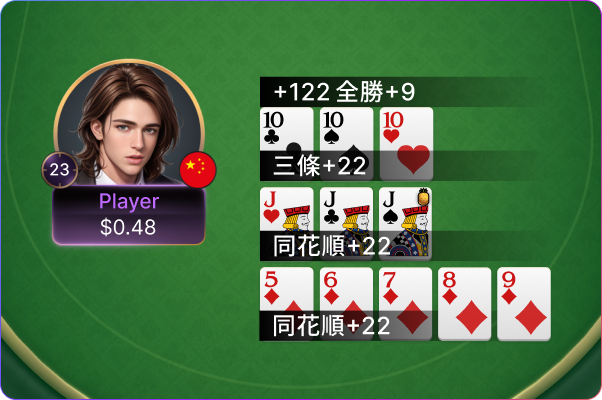
Each player's total score consists of base points and hand-type bonus points:
Base Points:
- Winning all three piles: +3 extra points.
- Compare each pile (Front, Middle, Back): Win +1, Lose -1, Tie 0.
- A player who busts earns no base points and is considered to have lost all three piles against non-busted players.
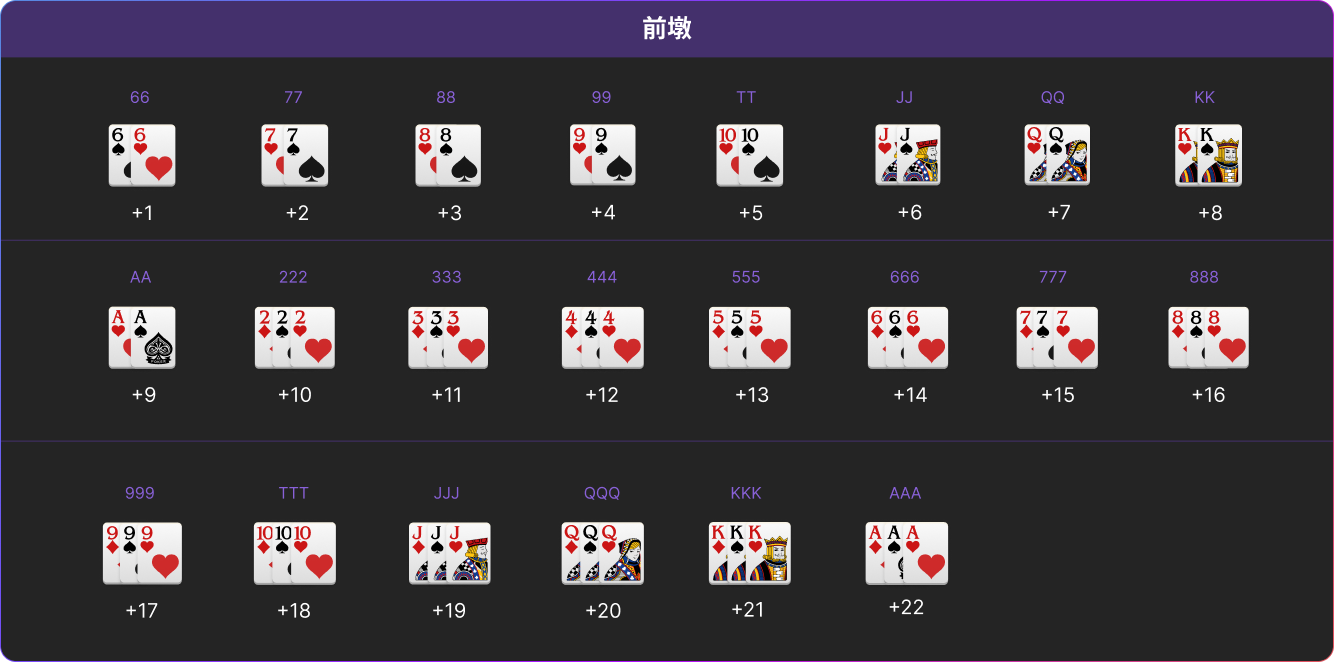
Hand-type Points:
- Completing specific hand types grants additional points (according to mode rules).
Final Result = Total Score × Ante
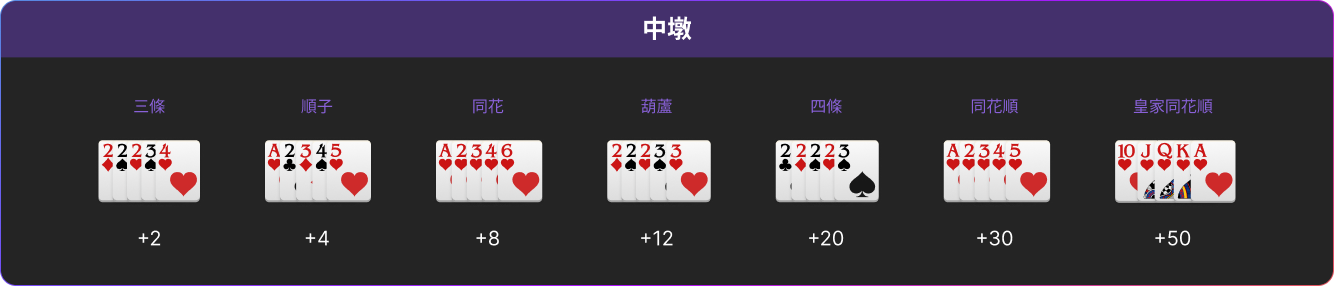
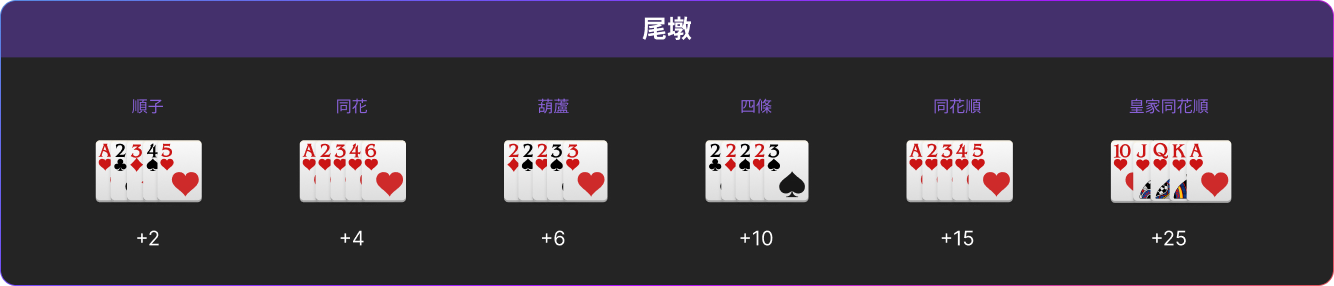
Game Modes:
Normal Mode
- When entering Fantasy Mode, players receive a fixed 14-card hand.
Blood Battle Mode:
- Upon first entering Fantasy Mode, card quantity is based on the front-hand combination.
- If entering Fantasy Mode consecutively, the number of cards is fixed at 14.
Blood-In Blood-Out Mode:
- Upon first entering Fantasy Mode, cards are granted according to the front-hand combination.
- If entering Fantasy Mode consecutively, the number of cards remains the same as the first Fantasy entry.
- JOKER Mode: Includes 2 Jokers (total 54 cards). Jokers may act as any card.
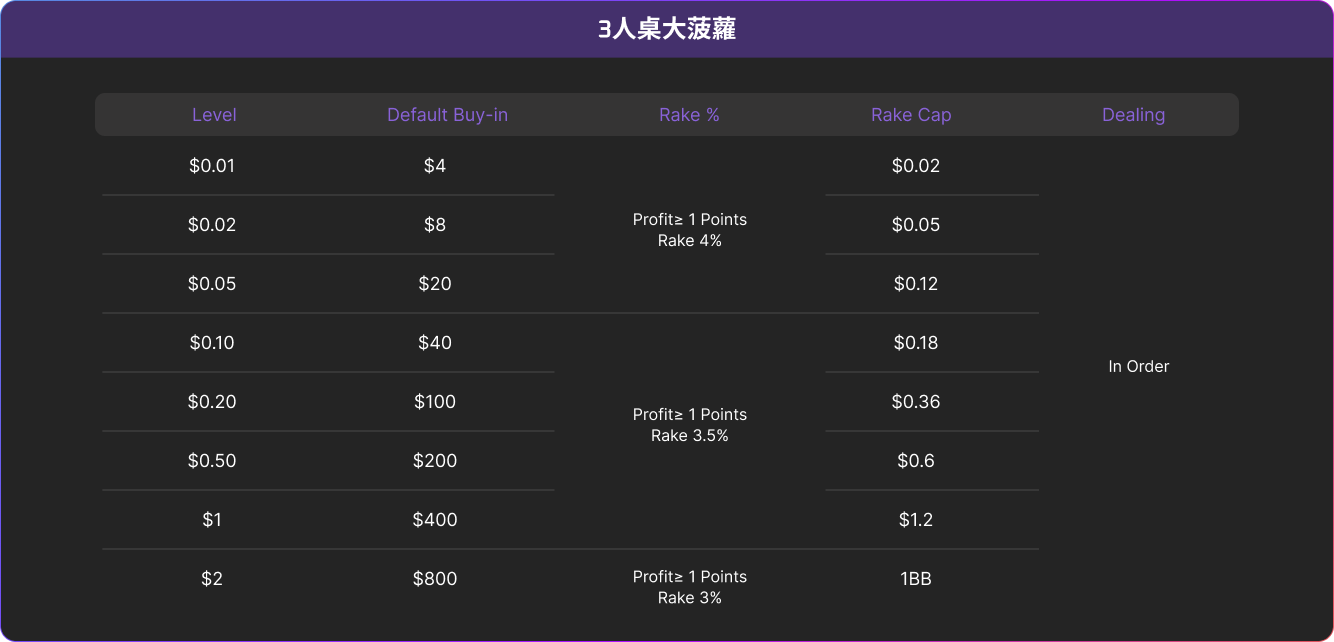
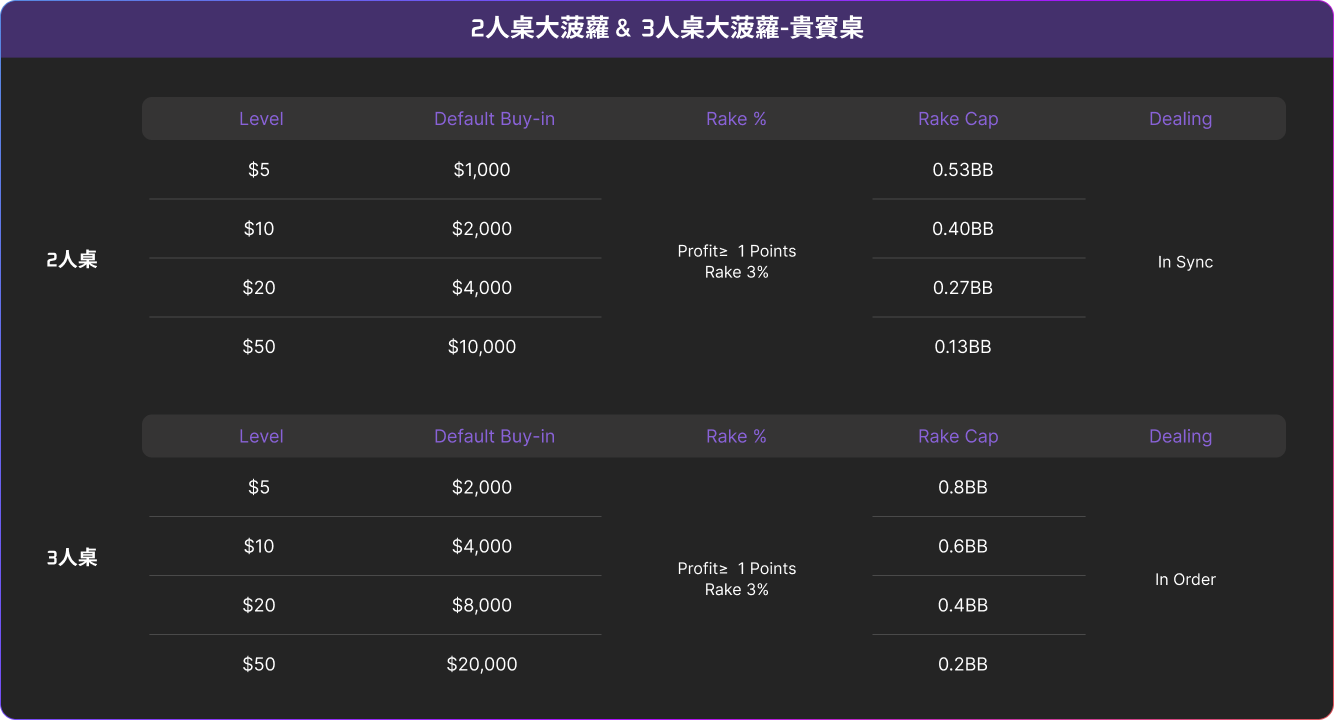
Fantasy Mode Rules
If a player does not bust and has QQ or better on the front pile, they enter Fantasy Mode next round.
Depending on the mode, players receive 14–17 cards in Fantasy Mode and must select 13 to form their piles.
Normal Mode – Front Hand & Cards Received:
- Always receive 14 cards.
Blood Battle / Blood-In Blood-Out – Front Hand & Cards Received:
- QQ: 14 cards
- KK: 15 cards
- AA or any Three of a Kind: 16 cards
Blood-In Blood-Out + JOKER – Front Hand & Cards Received:
- QQ: 14 cards
- KK: 15 cards
- AA: 16 cards
- Any Three of a Kind: 17 cards
Conditions to remain in Fantasy Mode:
- Front pile is Three of a Kind.
- Back pile is Four of a Kind or higher.
During Fantasy Mode, the player cannot leave the table and no new players may join.

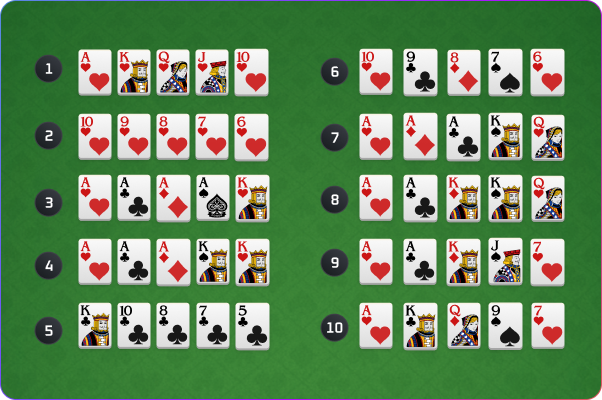
Hand Strength (Highest to Lowest)
Texas Hold'em compares hand types, not suits. Ace is highest, 2 is lowest.
- Royal Flush – A-K-Q-J-10 of the same suit, strongest hand
- Straight Flush – five consecutive cards of the same suit
- Four of a Kind – four cards of identical rank
- Full House – three of a kind + one pair
- Flush – five cards of the same suit, not in sequence
- Straight – five consecutive cards of mixed suits
- Three of a Kind – three cards of the same rank
- Two Pair – two separate pairs
- One Pair – two cards of identical rank
- High Card – none of the above, highest card determines strength
EV Cash Out
Concept:
- EV Cash Out is triggered when you and an opponent go All-in. The platform calculates your expected value (equity) based on your current win probability, and instantly pays out that amount — regardless of the actual outcome of the hand.
- The result is no longer based on the showdown, but is instead settled immediately using mathematical probability.
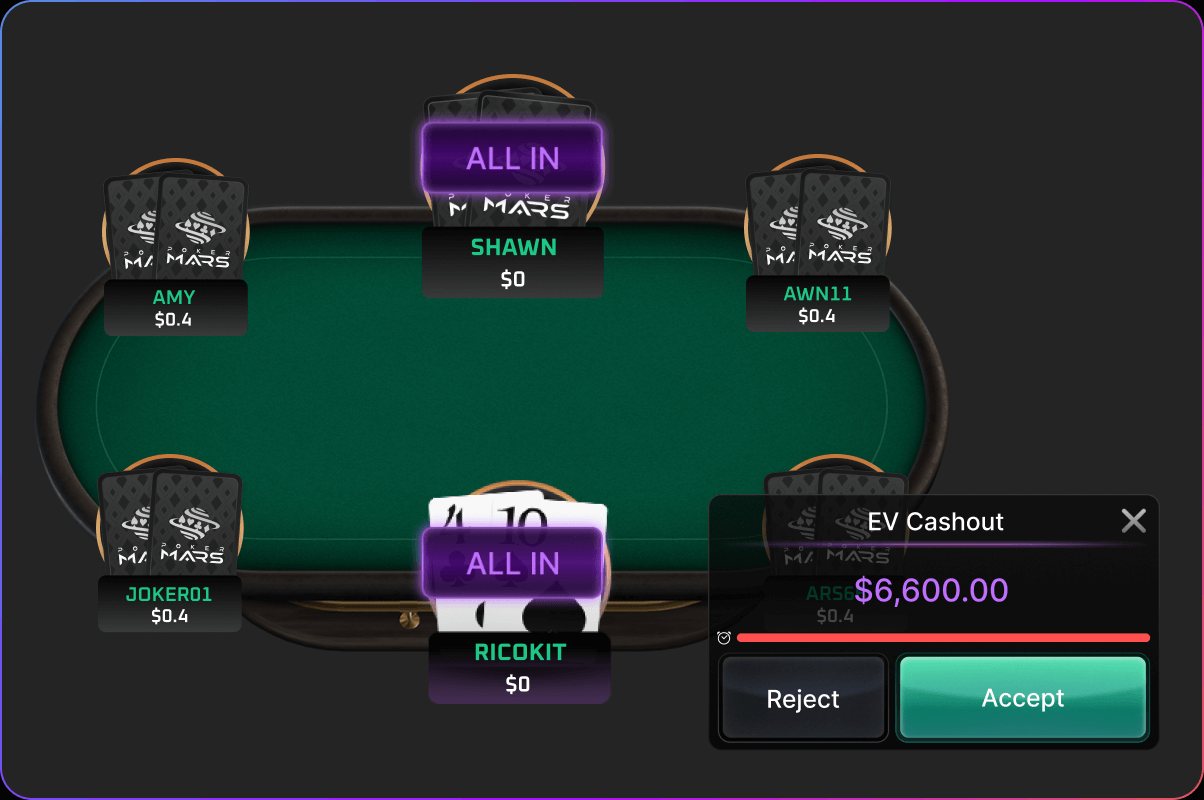
When to Use EV Cash Out:
- Multiple players are All-in simultaneously.
- EV CASH OUT can only be triggered on the Flop and Turn.
- When the advantaged player's equity (including ties) is above 60% (and they must have the highest equity among all players), while the disadvantaged player's equity (including ties) is below 60%.
- Each player can use EV (Cash Out) a maximum of once per hand. If EV is not used on the Flop, there is still an opportunity to select EV on the Turn.
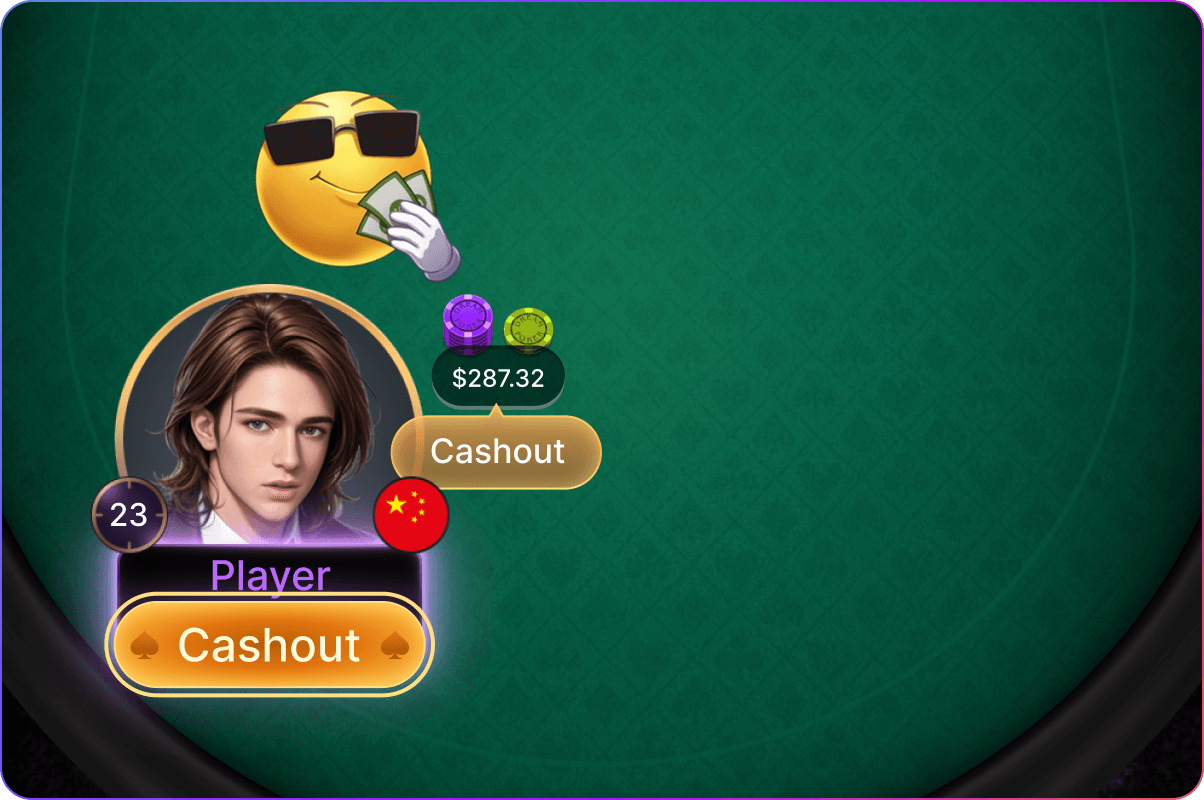
- After EV is taken, if any subsequent card causes your hand to be outdrawn/surpassed, the EV cashback amount is immediately paid out.
- After EV is taken, regardless of the player's win or loss, the disposition rights of the pot belong entirely to the system.
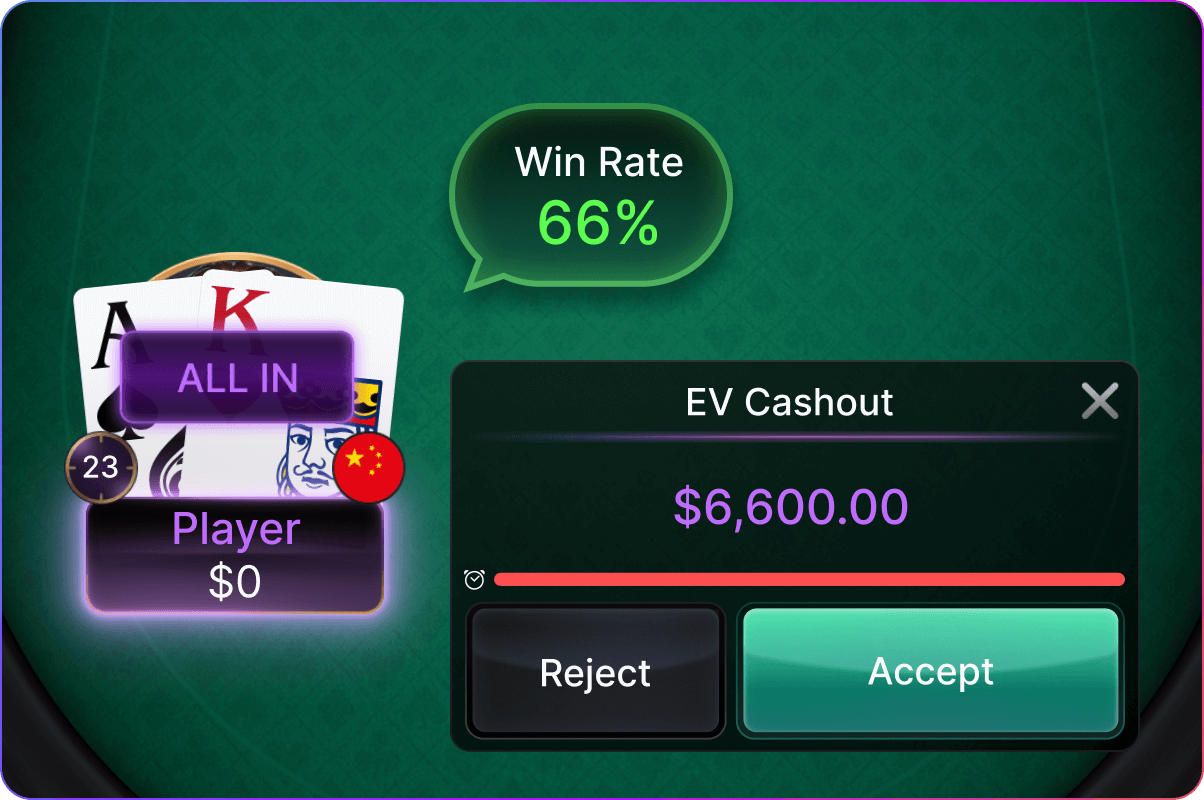
Why Use EV CASH OUT?
- Stable Long-Term Profit: Maintains your EV (Expected Value) income even with short-term losses.
- Precise Bankroll Management: Prevents losing your entire stack due to a single bad beat or cooler.
- Zero-Risk Principal Protection: Receive your money in advance, eliminating the risk of the showdown.
- No Emotional Fluctuation: Reduces the frustration of losing despite having high equity.
Time Bank
Basic Concept:
- The Time Bank is an extra thinking time feature in Texas Hold’em, allowing players more time to decide during critical or complex situations.
- Each player has a fixed total amount of time (e.g., 30 seconds).
- If a player fails to act within the regular time limit, the system will automatically activate the Time Bank.
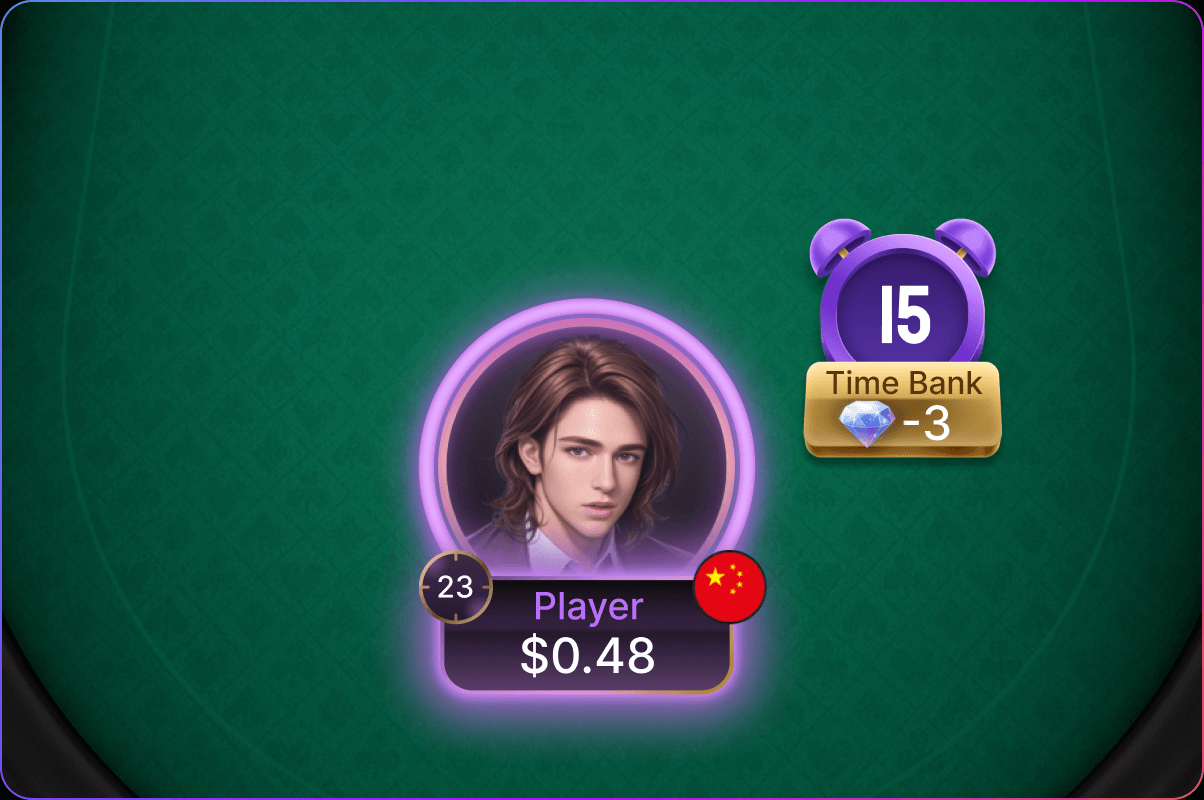
How Time Bank Works
- Automatic Activation : When the regular decision time runs out, the Time Bank is automatically triggered.
- Multiple Uses : The Time Bank can be used multiple times in a game until the time runs out.
- Time Limit : Each player has a fixed total amount of time (e.g., 30 seconds).
- Replenishment : Some platforms replenish Time Bank seconds after a certain number of hands or upon reaching the final table.
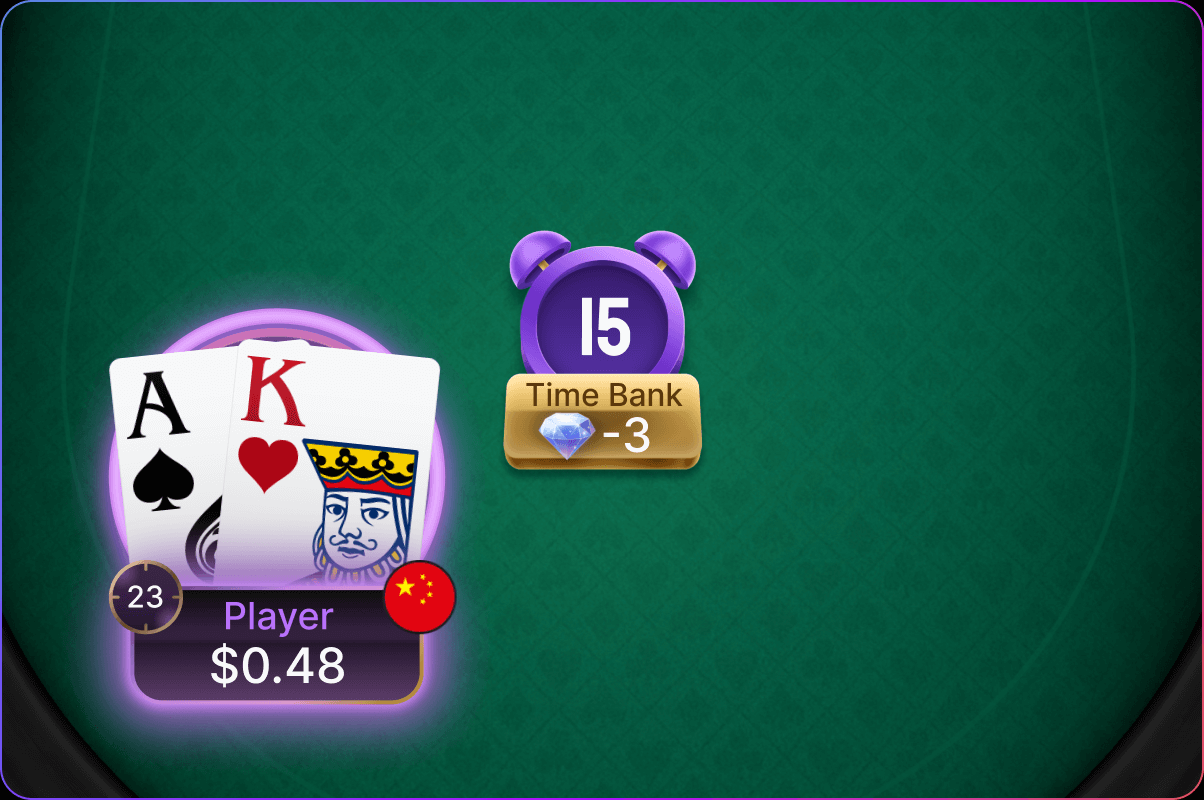
Example Flow:
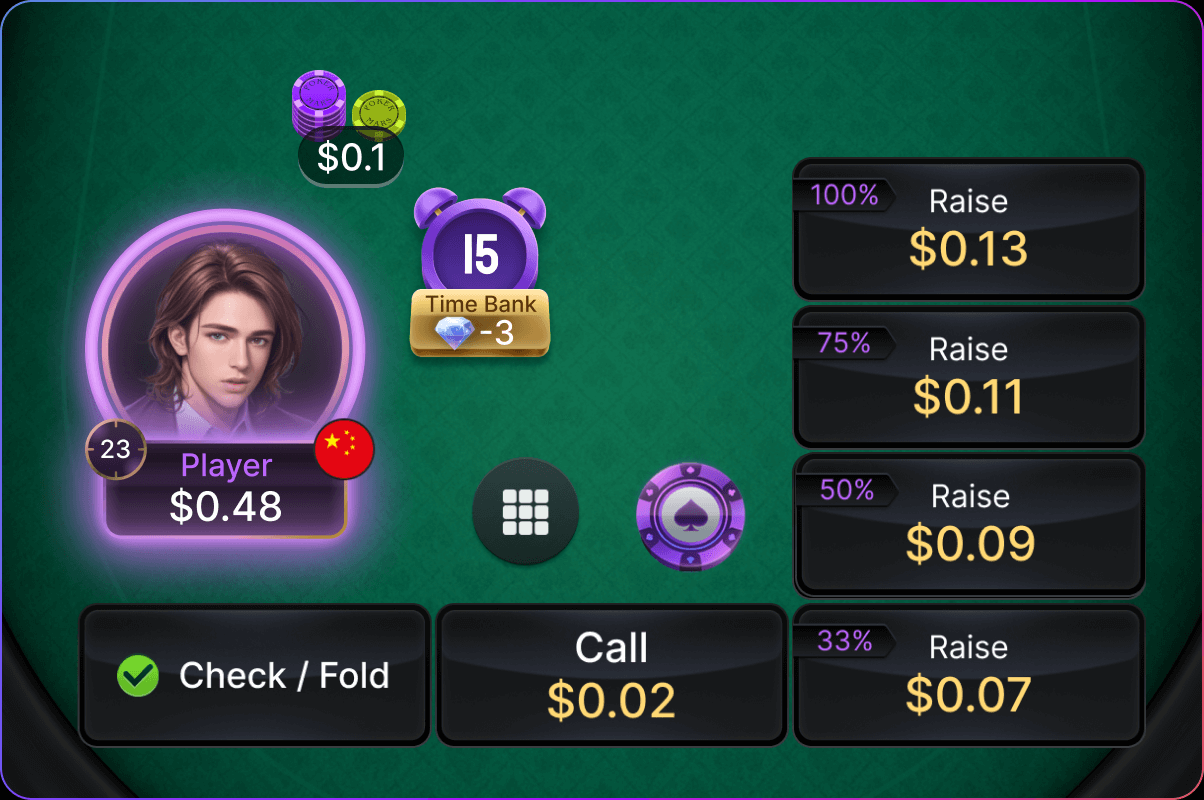
- It's your turn to act → A 15-second countdown begins.
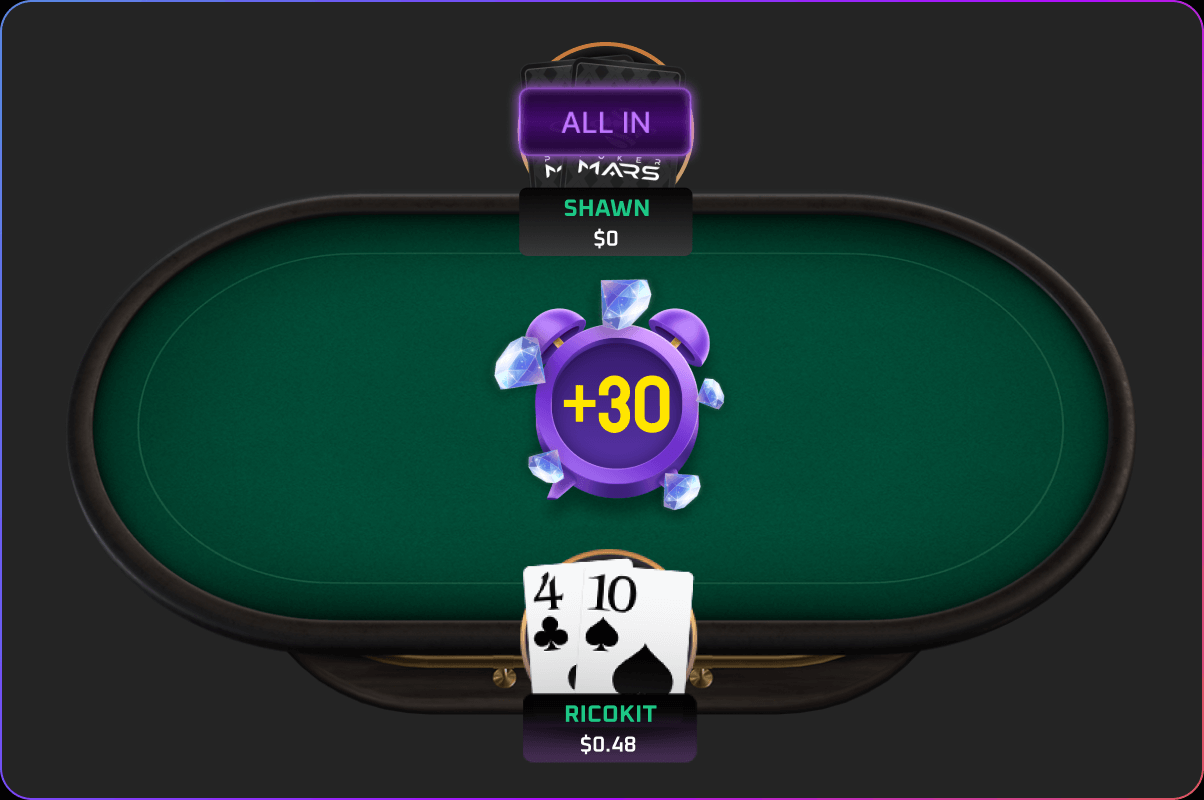
- You haven’t made a decision → When time runs out, the system automatically activates your 30-second Time Bank.
- You make a decision within the Time Bank (e.g., All-in / Fold).
- The remaining time is deducted from your total Time Bank.
When is the Time Bank Most Useful?
- Opponent goes All-in, and you need time to consider whether to call.
- A critical Turn card is dealt — you need extra time to evaluate your odds.
- You're facing an unknown opponent and need time to analyze their betting patterns.
- You're in a high-stakes tournament, where decisions require extra caution.
Actual Time Bank Usage:
Public Tables:
- Time Limit: 30s
- Replenishment: Free replenishment, but requires playing 40 hands at the same table (starting from the next hand after first use, when 29s remain) to fully recharge 30s
- Activation Prompt: Only appears when decision time is down to 7 seconds
Private Tables:
- Time Limit: 30s
- Replenishment: Unlimited replenishment by deducting 3 Diamonds
- Activation Prompt: Immediately
Private Room
Description
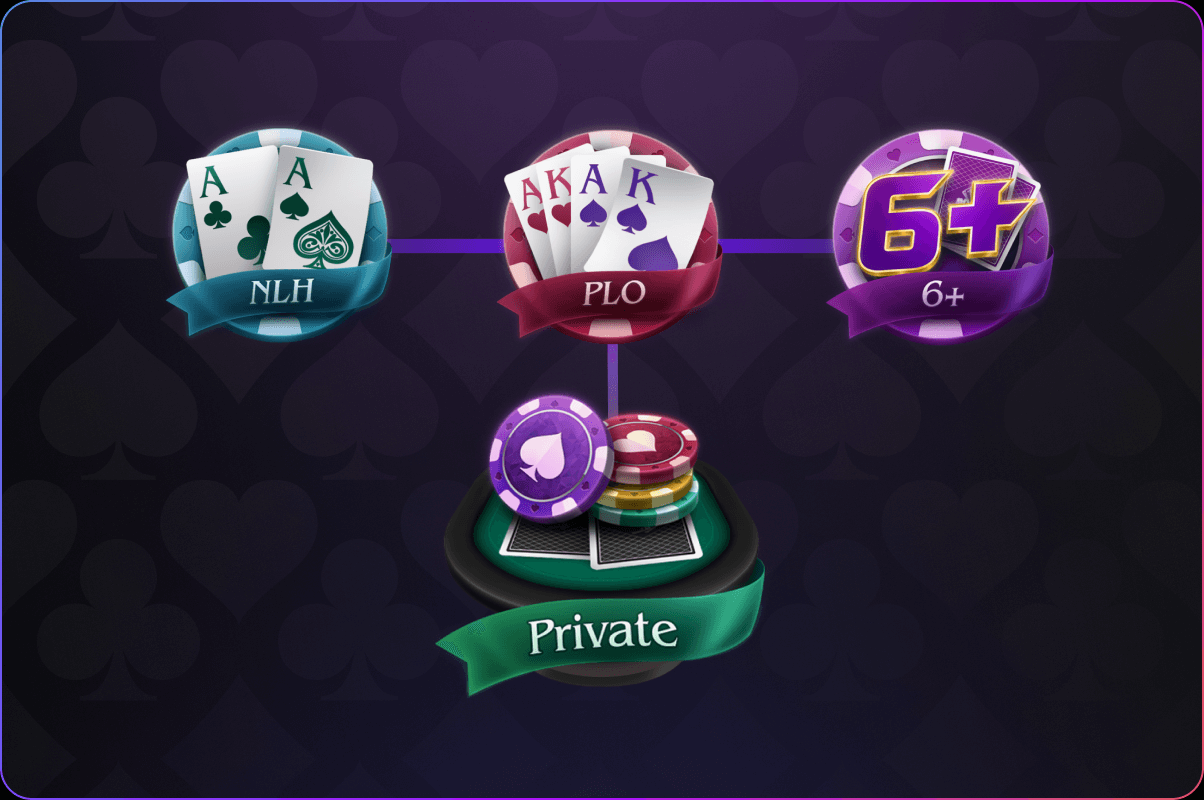
- Supported Game Types: Texas Hold'em / Short Deck / Omaha
- Table Creation Fee: Starting from 30 Diamonds per table per hour
- Host Settings Include: Blinds, Password, Game Type
- Timer Starts Immediately Upon Creation, Cannot Be Paused
- Deduct 150 Diamonds to expand by +5 tables, up to a maximum of 20 tables
- Host Revenue Share: As per platform settings
How many game types are available?
In private rooms, players can freely select and set up the following game modes:
- Classic Hold'em: No Limit Texas Hold'em
- Short Deck Hold'em: Short Deck (2s-5s removed, 36 cards total)
- Omaha Poker: Omaha, 5-card Omaha
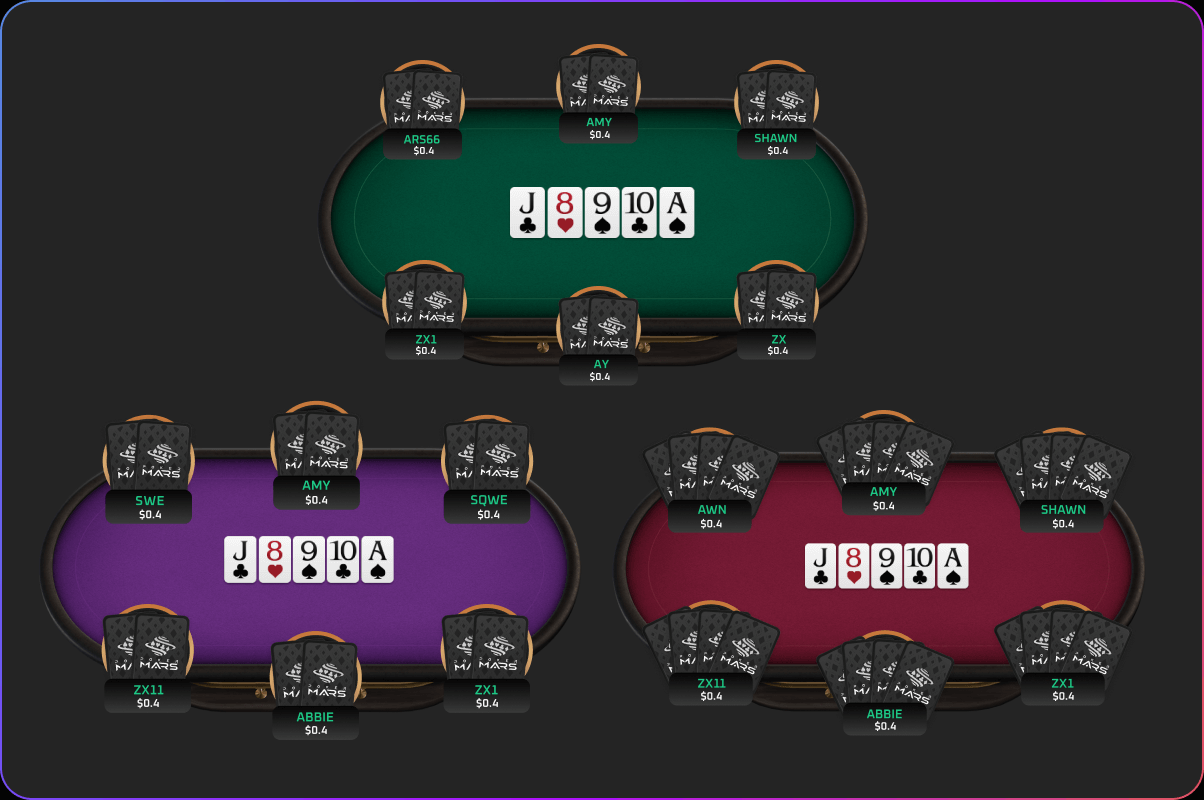
Table Creation Requirement:
How many Diamonds are consumed per hour?
Diamonds are paid by the host, only a one-time activation is needed; players do not need to pay extra to enter.
Each game's pot rake has an upper limit, and the host's share is determined by the platform's settings.
- Basic Table Creation Fee: 1 table = 30 Diamonds per hour (subject to platform adjustments)
- Timer Starts Immediately: Time calculation begins upon successful room creation; cannot be paused / pausing does not reduce cost
- Room Duration: Automatically billed hourly, automatically closes when time is up, with a maximum duration of 12 hours.
- Termination Conditions: Automatically closes when time is up.

Regarding the Room Timer Mechanism
- Billing and countdown commence immediately once a room is created.
- Time calculation and Diamond consumption will continue even if the room is empty or inactive.
- Cannot be paused, cannot be delayed.
- The auto-close function will forcefully close the room once the set time is reached.
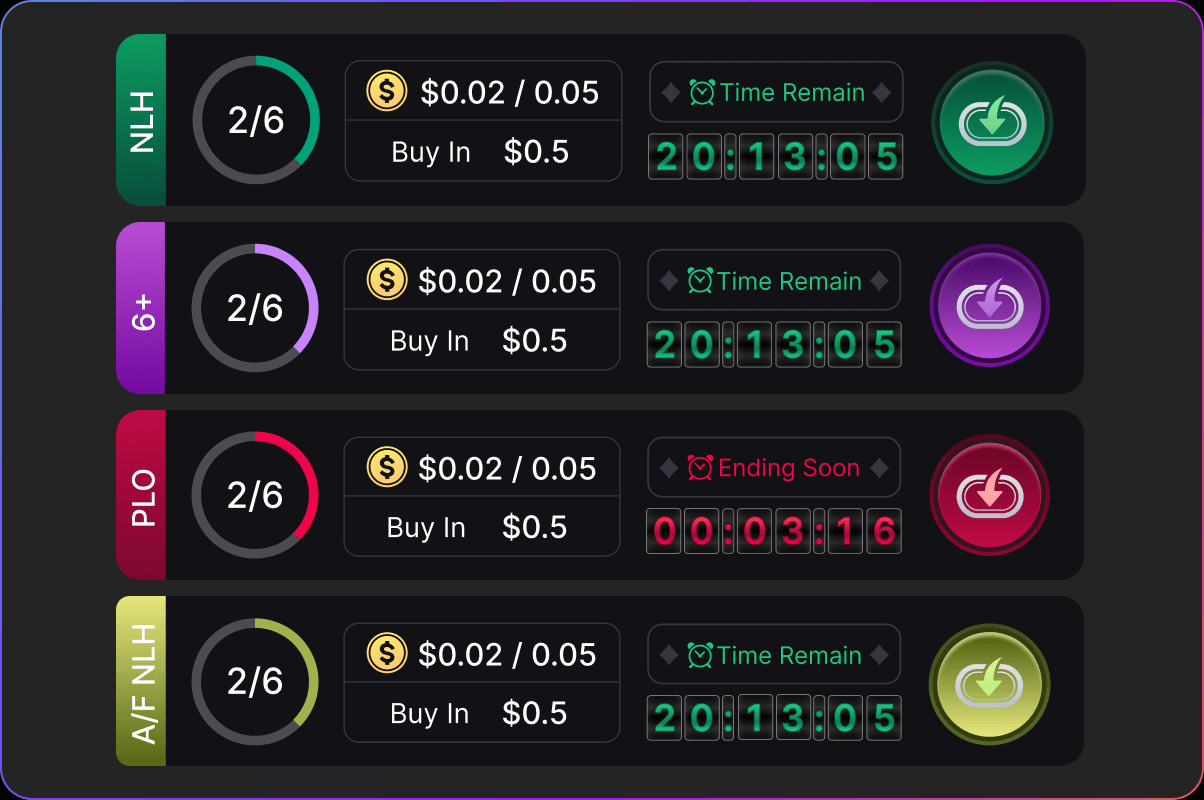
What parameters can the host customize?
Game Parameters:
- Game Mode (Texas Hold'em / Short Deck / Omaha)
- Blinds Level / Starting Chips
- Max Buy-in / Min Buy-in
Player Settings:
Max Players Per Table (4, 6 players)
Access Control:
Join/Spectate via Invitation Code (Time-limited)
Billing Method:
Hourly Billing
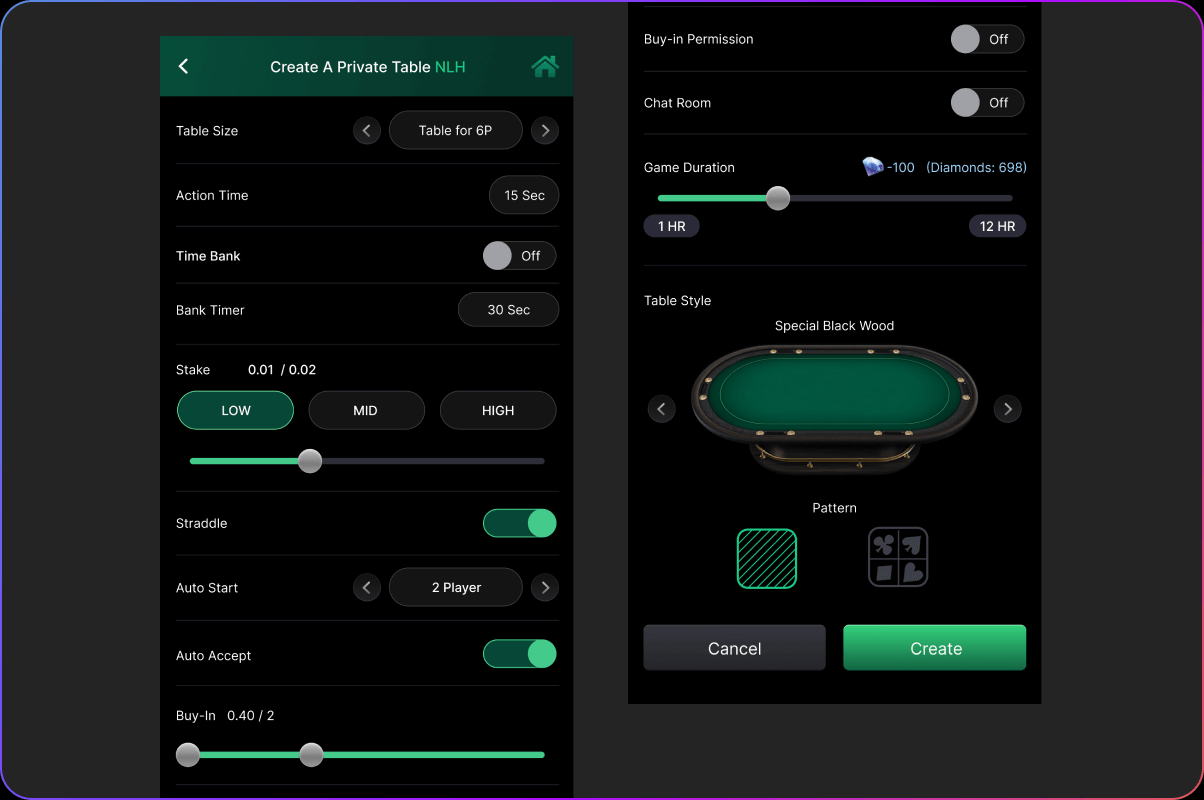
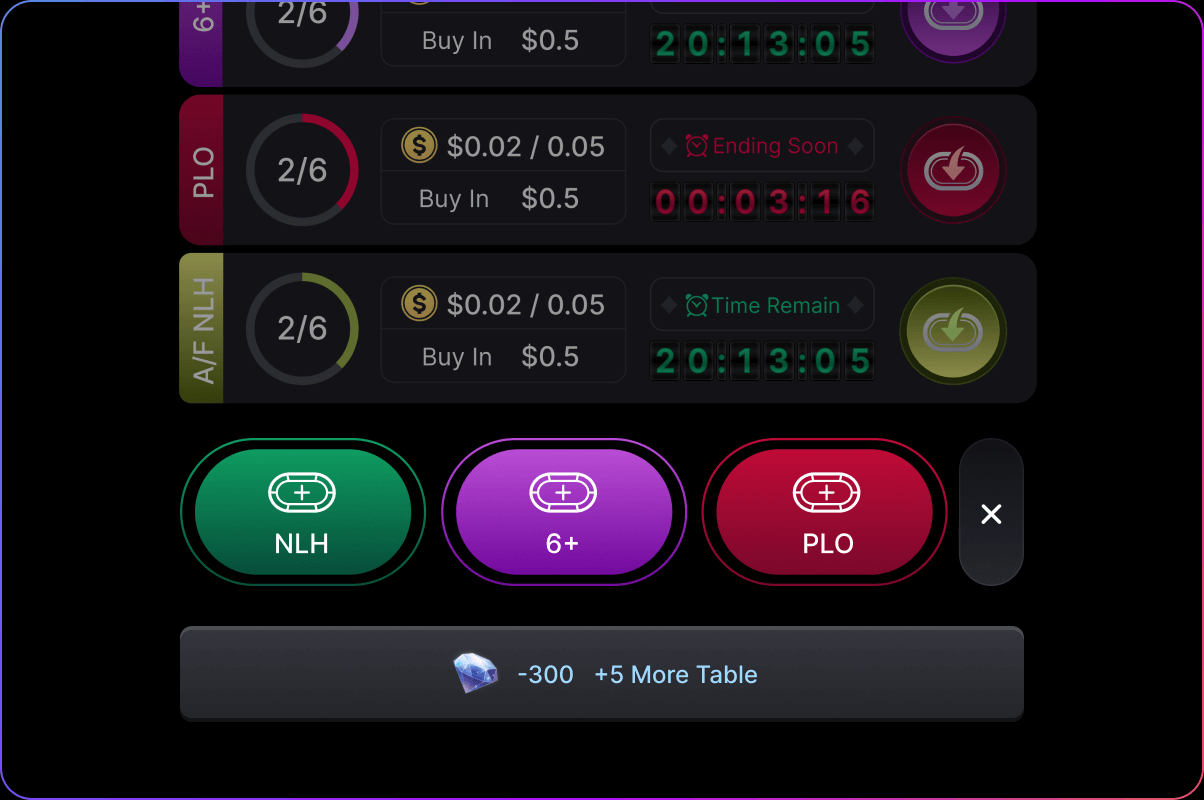
Table Space and Diamond Expansion Rules
Hosts can gradually expand table space as needed, or gain eligibility for free expansion during event periods.
- Initial Table Space: 5 private tables can be open simultaneously.
- Expansion Method: Consume additional Diamonds to unlock more table slots (deduct 150 Diamonds for +5 tables).
- Maximum Limit: Up to 20 private tables can be open simultaneously (varies by platform).
- Concurrent Online Limit: Maximum 4 or 6 players per table + observer slots.
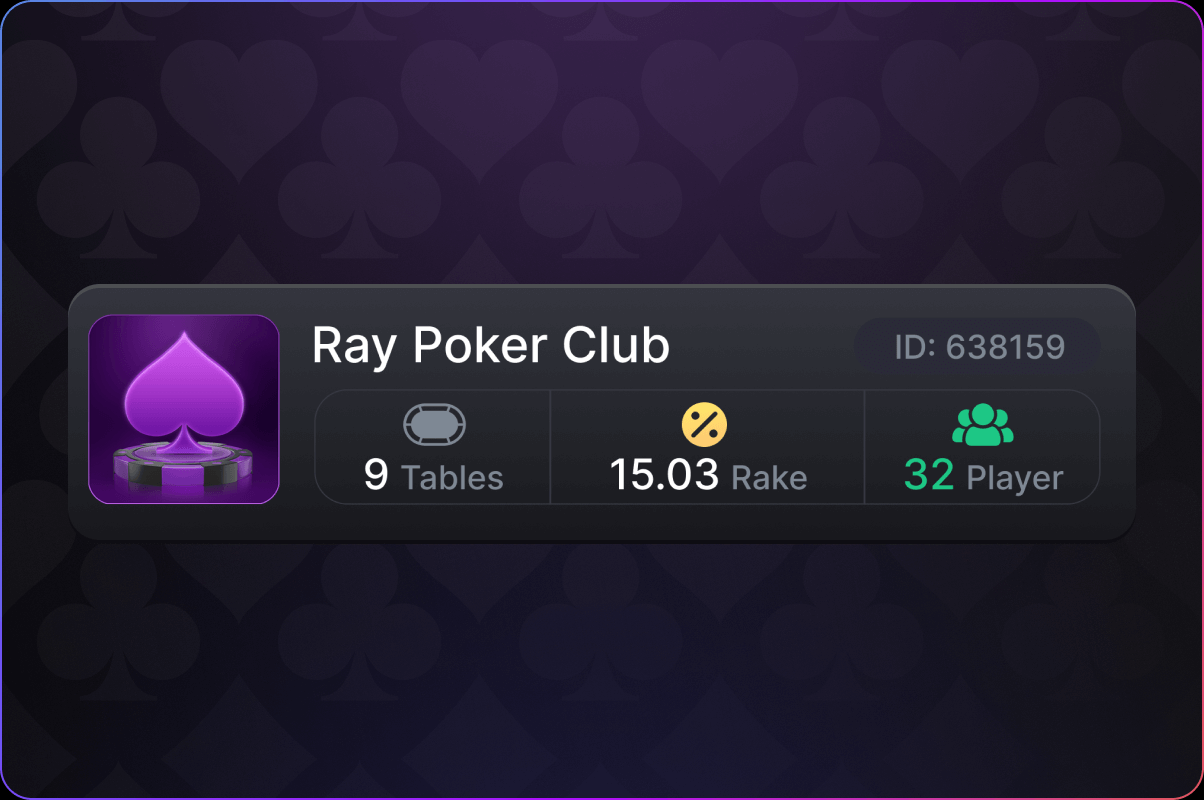
Host's Revenue Share (Profit Rebate)
If a private room is set to "Raked Pot Game," the platform will share a portion of the rake from each hand with the host.
If the host chooses to open a "Friendly Table / No Rake Mode," there will be no revenue share for the host, but the platform will also not deduct any rake.
- Platform Rake: As per platform settings
- Host's Revenue As per platform settings
- Revenue Share Timing: After a private table closes, the revenue share will be credited to the player's account for withdrawal.
- Restrictions: If the host violates rules (e.g., operating "feeder" tables, cheating), it will be handled according to each platform's settings.
Run It Multiple Times
Concept:
Only when the last two players go All-in can they agree to a multi-board play, such as:
"For this hand, let's not just deal the community cards (Flop-Turn-River) once. Instead, deal them multiple times, compare hands multiple times, and split the pot accordingly."
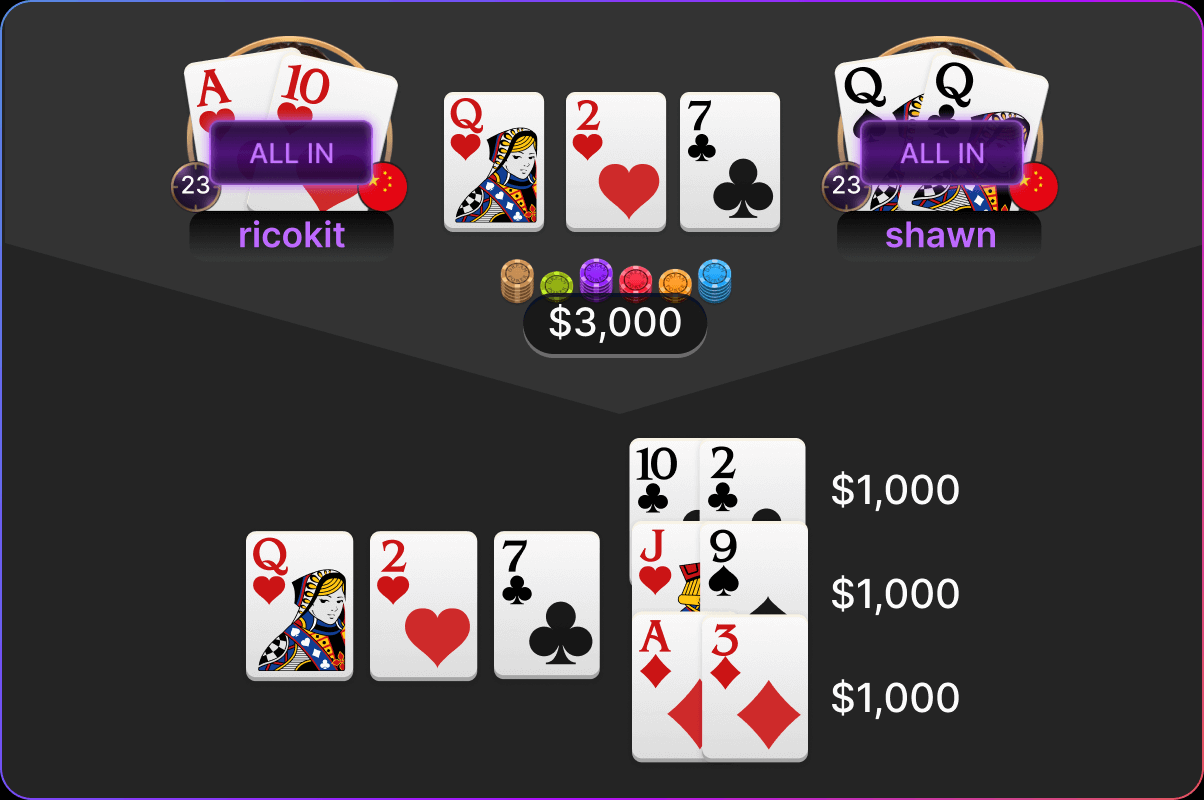
Common Deal Methods
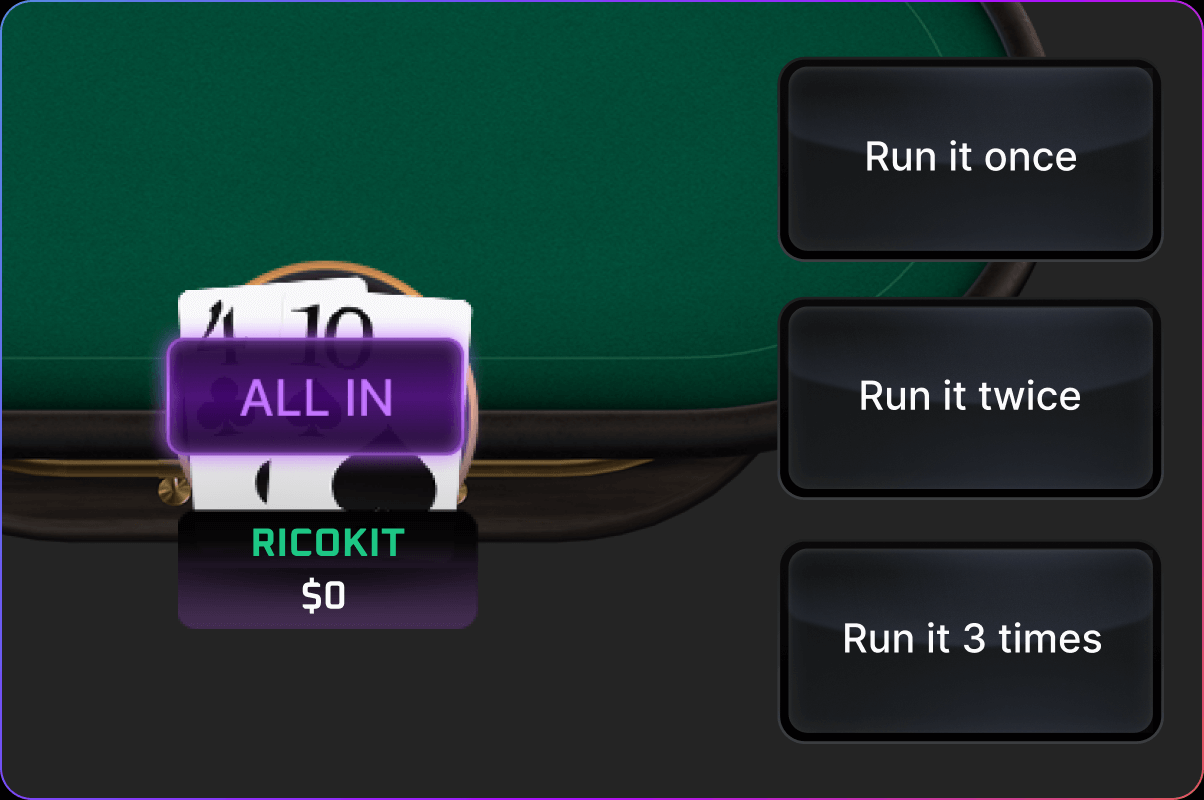
Run It Once:
- Community Boards: Standard one-time Flop–Turn–River
- Showdown Method: One showdown
- Pot Distribution: Winner takes the entire pot
Run It Twice:
- Community Boards: Two separate Flop–Turn–River boards
- Showdown Method: Two showdowns
- Pot Distribution: Each winner takes half of the pot
Run It 3 Times:
- Community Boards: Three separate community card runs
- Showdown Method: Three showdowns
- Pot Distribution: Each winner takes one-third of the pot
Time Bank
Basic Concept:
- The Time Bank is an extra thinking time feature in Texas Hold’em, allowing players more time to decide during critical or complex situations.
- Each player has a fixed total amount of time (e.g., 30 seconds).
- If a player fails to act within the regular time limit, the system will automatically activate the Time Bank.
How Time Bank Works
- Automatic Activation : When the regular decision time runs out, the Time Bank is automatically triggered.
- Multiple Uses : The Time Bank can be used multiple times in a game until the time runs out.
- Time Limit : Each player has a fixed total amount of time (e.g., 30 seconds).
- Replenishment : Some platforms replenish Time Bank seconds after a certain number of hands or upon reaching the final table.
Example Flow:
- It's your turn to act → A 15-second countdown begins.
- You haven’t made a decision → When time runs out, the system automatically activates your 30-second Time Bank.
- You make a decision within the Time Bank (e.g., All-in / Fold).
- The remaining time is deducted from your total Time Bank.
When is the Time Bank Most Useful?
- Opponent goes All-in, and you need time to consider whether to call.
- A critical Turn card is dealt — you need extra time to evaluate your odds.
- You're facing an unknown opponent and need time to analyze their betting patterns.
- You're in a high-stakes tournament, where decisions require extra caution.
Actual Time Bank Usage:
Public Tables:
- Time Limit: 30s
- Replenishment: Free replenishment, but requires playing 40 hands at the same table (starting from the next hand after first use, when 29s remain) to fully recharge 30s
- Activation Prompt: Only appears when decision time is down to 7 seconds
Private Tables:
- Time Limit: 30s
- Replenishment: Unlimited replenishment by deducting 3 Diamonds
- Activation Prompt: Immediately
Private Room
Description
- Supported Game Types: Texas Hold'em / Short Deck / Omaha
- Table Creation Fee: Starting from 30 Diamonds per table per hour
- Host Settings Include: Blinds, Password, Game Type
- Timer Starts Immediately Upon Creation, Cannot Be Paused
- Deduct 150 Diamonds to expand by +5 tables, up to a maximum of 20 tables
- Host Revenue Share: As per platform settings
How many game types are available?
In private rooms, players can freely select and set up the following game modes:
- Classic Hold'em: No Limit Texas Hold'em
- Short Deck Hold'em: Short Deck (2s-5s removed, 36 cards total)
- Omaha Poker: Omaha, 5-card Omaha
Table Creation Requirement:
How many Diamonds are consumed per hour?
Diamonds are paid by the host, only a one-time activation is needed; players do not need to pay extra to enter.
Each game's pot rake has an upper limit, and the host's share is determined by the platform's settings.
- Basic Table Creation Fee: 1 table = 30 Diamonds per hour (subject to platform adjustments)
- Timer Starts Immediately: Time calculation begins upon successful room creation; cannot be paused / pausing does not reduce cost
- Room Duration: Automatically billed hourly, automatically closes when time is up, with a maximum duration of 12 hours.
- Termination Conditions: Automatically closes when time is up.
Regarding the Room Timer Mechanism
- Billing and countdown commence immediately once a room is created.
- Time calculation and Diamond consumption will continue even if the room is empty or inactive.
- Cannot be paused, cannot be delayed.
- The auto-close function will forcefully close the room once the set time is reached.
What parameters can the host customize?
Game Parameters:
- Game Mode (Texas Hold'em / Short Deck / Omaha)
- Blinds Level / Starting Chips
- Max Buy-in / Min Buy-in
Player Settings:
Max Players Per Table (4, 6 players)
Access Control:
Join/Spectate via Invitation Code (Time-limited)
Billing Method:
Hourly Billing
Table Space and Diamond Expansion Rules
Hosts can gradually expand table space as needed, or gain eligibility for free expansion during event periods.
- Initial Table Space: 5 private tables can be open simultaneously.
- Expansion Method: Consume additional Diamonds to unlock more table slots (deduct 150 Diamonds for +5 tables).
- Maximum Limit: Up to 20 private tables can be open simultaneously (varies by platform).
- Concurrent Online Limit: Maximum 4 or 6 players per table + observer slots.
Host's Revenue Share (Profit Rebate)
If a private room is set to "Raked Pot Game," the platform will share a portion of the rake from each hand with the host.
If the host chooses to open a "Friendly Table / No Rake Mode," there will be no revenue share for the host, but the platform will also not deduct any rake.
- Platform Rake: As per platform settings
- Host's Revenue As per platform settings
- Revenue Share Timing: After a private table closes, the revenue share will be credited to the player's account for withdrawal.
- Restrictions: If the host violates rules (e.g., operating "feeder" tables, cheating), it will be handled according to each platform's settings.
Run It Multiple Times
Concept:
Only when the last two players go All-in can they agree to a multi-board play, such as:
"For this hand, let's not just deal the community cards (Flop-Turn-River) once. Instead, deal them multiple times, compare hands multiple times, and split the pot accordingly."
Common Deal Methods
Run It Once:
- Community Boards: Standard one-time Flop–Turn–River
- Showdown Method: One showdown
- Pot Distribution: Winner takes the entire pot
Run It Twice:
- Community Boards: Two separate Flop–Turn–River boards
- Showdown Method: Two showdowns
- Pot Distribution: Each winner takes half of the pot
Run It 3 Times:
- Community Boards: Three separate community card runs
- Showdown Method: Three showdowns
- Pot Distribution: Each winner takes one-third of the pot